

The anther is the part of the stamen where pollen grains are formed. To understand how pollen is formed, it is first necessary to look at the structure of the microsporangium, the part of the anther where the early stages of pollen development take place.
Structure of Microsporangium
A typical young anther is bilobed, and each lobe usually contains two microsporangia, giving a total of four microsporangia. The microsporangia develop further and become pollen sacs, which contain the developing pollen grains.
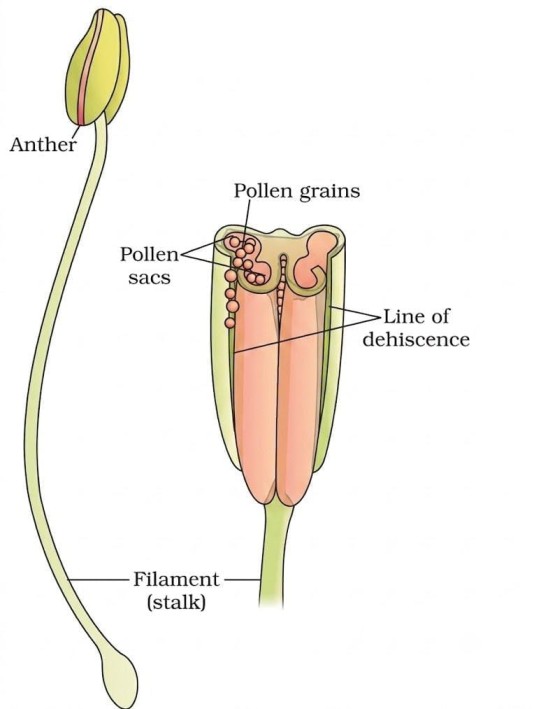
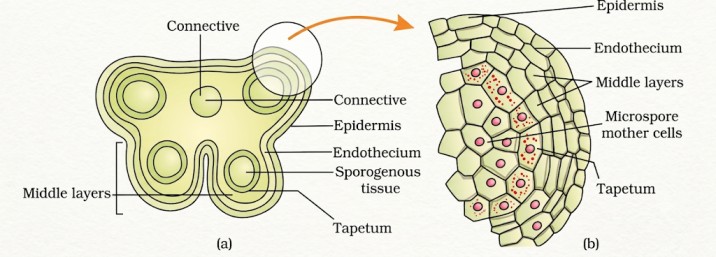
A transverse section of a young microsporangium shows a wall surrounding the inner sporogenous tissue. From the outside towards the inside, the wall consists of four layers:
- Epidermis
- Endothecium
- Middle layers
- Tapetum
Inside these wall layers lies the sporogenous tissue, which produces the cells involved in pollen formation.
The Four Wall Layers
Each wall layer has a specific role in the development and release of pollen grains.
- Epidermis
The epidermis forms the outermost protective layer of the microsporangium.
- Endothecium
The endothecium lies just beneath the epidermis..
- Middle Layers
The middle layers lie between the endothecium and tapetum.
These three wall layers perform the functions of protection and help in dehiscence of anther to release the pollen grain
- Tapetum
The tapetum is the innermost wall layer and surrounds the sporogenous tissue. It provides nourishment to the developing pollen grains and supplies materials required for their development. The tapetum is therefore considered the most important nutritive layer of the microsporangium.
What Happens Inside the Microsporangium?
The innermost region of the microsporangium contains sporogenous tissue. As the anther develops, cells of this tissue differentiate into pollen mother cells, also called microspore mother cells.
These cells are the starting point for the formation of microspores. The formation of microspores from these pollen mother cells through meiosis is called microsporogenesis.
Microsporogenesis
Microsporogenesis is the process by which microspores are formed from pollen mother cells through meiosis. The process can be understood as a sequence of events.
A pollen mother cell undergoes meiosis. Since meiosis reduces the chromosome number by half, each pollen mother cell produces four haploid microspores. Initially, the four microspores remain together as a group called a microspore tetrad.
As development continues, the microspores separate and develop into pollen grains.
The basic sequence is:
Structure of a Pollen Grain
Pollen grains represent the male gametophytes of flowering plants. They are generally spherical and usually measure about 25-50 µm in diameter.
A pollen grain has a two-layered wall:
- Exine: The outer layer of the pollen grain. It is made of sporopollenin, a highly resistant organic material that helps the pollen grains remain well preserved, even as fossils.
- Intine: The inner wall of the pollen grain. It is a thin, continuous layer made of cellulose and pectin.
- Germ pores: These are openings in the exine where sporopollenin is absent. The pollen tube emerges through a germ pore during pollen germination.
Development of Pollen Grains
The microspores formed through microsporogenesis do not remain simple cells. Each microspore develops into a pollen grain, which represents the developing male gametophyte.
As the pollen grain develops, its nucleus divides mitotically to form two cells:
- Vegetative cell
- Generative cell
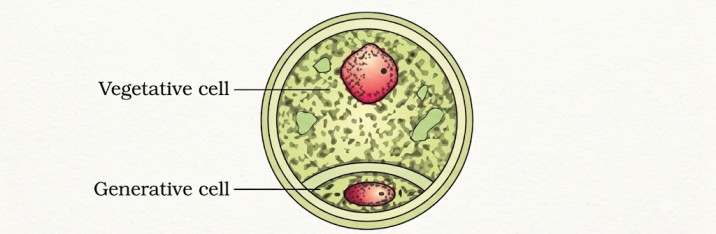
The vegetative cell is larger and is responsible for forming the pollen tube after the pollen grain reaches a compatible stigma. The generative cell is smaller and later divides mitotically to form two male gametes.
Therefore, depending on the stage at which pollen is released from the anther, it may be two-celled, containing a vegetative cell and a generative cell, or three-celled, containing a vegetative cell and two male gametes.
These male gametes will later be transported through the pollen tube during fertilisation.
From Anther to Pollen
The complete sequence can now be followed from the beginning:
Anther → Microsporangium → Sporogenous tissue → Pollen mother cells → Meiosis → Microspores → Pollen grains (Male gametophyte)
The microsporangium therefore provides the site for the formation and early development of pollen, while microsporogenesis is the specific process through which pollen mother cells produce haploid microspores.
Important Points to Remember
- A typical young anther is bilobed and usually contains four microsporangia.
- The microsporangia develop further and become pollen sacs containing pollen grains.
- The four wall layers are epidermis, endothecium, middle layers, and tapetum.
- Tapetum is the innermost wall layer and provides nourishment to developing pollen grains.
- Pollen mother cells undergo meiosis to produce haploid microspores.
- The formation of microspores from pollen mother cells is called microsporogenesis.
- A group of four microspores formed after meiosis is called a microspore tetrad.
- Microspores develop into pollen grains, which represent the male gametophyte.
- When pollen grain mature it contain two cells – vegetative and generative cells
- The generative cell eventually produces two male gametes.
- Pollen grains may be shed at the two-celled or three-celled stage.
FAQs
The four wall layers of a microsporangium, from outside to inside, are epidermis, endothecium, middle layers, and tapetum. The tapetum is the innermost layer and nourishes the developing pollen grains
The endothecium develops fibrous thickenings that help the anther split open and release mature pollen grains.
Microsporogenesis is the process of formation of haploid microspores from pollen mother cells through meiosis. A pollen mother cell produces four haploid microspores.
The generative cell divides mitotically to form two male gametes. These male gametes take part in double fertilisation in flowering plants.
One pollen mother cell undergoes meiosis and produces four haploid microspores, which develop into four pollen grains.
A two-celled pollen grain contains a vegetative cell and a generative cell.
The tapetum nourishes the developing pollen grains. It is the innermost wall layer of the microsporangium.