

Double fertilisation starts an important new stage in the reproductive process of a flowering plant. Once syngamy and triple fusion are complete, the products formed inside the embryo sac begin to develop.
The zygote develops into an embryo, while the primary endosperm nucleus develops into the endosperm. At the same time, the ovule develops into a seed and the ovary develops into a fruit.
The main sequence is:
Zygote → Embryo
Primary endosperm nucleus → Endosperm
Ovule → Seed
Ovary → Fruit
These changes are known as post-fertilisation events.
Development of Endosperm
Endosperm development begins before embryo development. This is important because the developing endosperm provides nourishment to the embryo.
After triple fusion, the central cell becomes the primary endosperm cell. It is triploid and undergoes repeated divisions to form the endosperm tissue.
The cells of the endosperm contain reserve food materials that are used for the nutrition of the developing embryo.
Types of Endosperm Development
In the most common type of endosperm development, the primary endosperm nucleus undergoes repeated nuclear divisions. These divisions initially occur without cell wall formation, producing many free nuclei. This stage is called free-nuclear endosperm. Later, cell wall formation occurs, and the endosperm becomes cellular.
The number of free nuclei formed before cellularisation can vary greatly.
Coconut provides a familiar example. The liquid inside a tender coconut is free-nuclear endosperm, while the surrounding white kernel is cellular endosperm.
Endosperm may either be completely used up by the developing embryo before the seed matures or remain in the mature seed.
Important sequence:
Primary endosperm cell → Repeated divisions → Endosperm → Nourishment of embryo
Development of the Embryo
The embryo develops at the micropylar end of the embryo sac, where the zygote is located. While the endosperm is developing, the zygote also begins the process of embryo development.
Most zygotes begin to divide only after some endosperm has already been formed. This provides assured nutrition to the developing embryo. The first division of the zygote is followed by a series of divisions and changes in the arrangement of cells. These cells gradually become organised into different parts of the embryo.
The early stages of embryo development are similar in monocotyledons and dicotyledons. In a dicot embryo, the zygote develops into a proembryo, followed by the globular, heart-shaped, and mature embryo stages.
Developmental sequence:
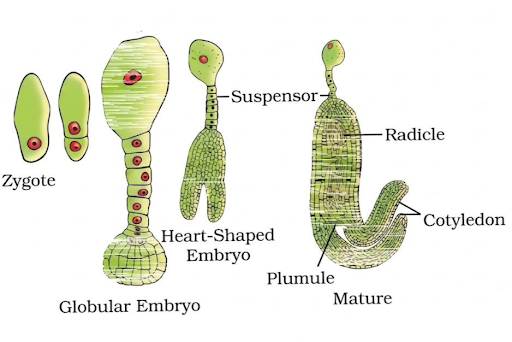
Zygote → Proembryo → Globular embryo → Heart-shaped embryo → Mature embryo
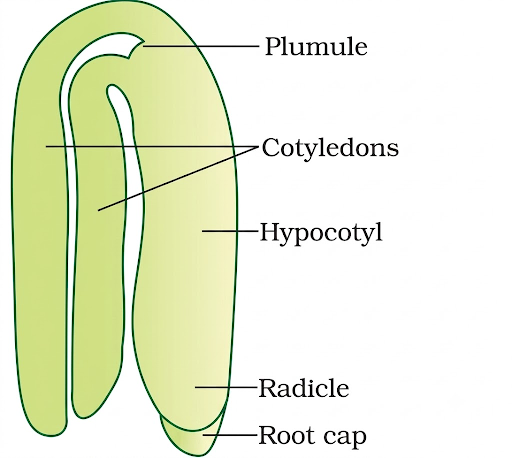
In a typical dicot embryo, two cotyledons develop along with the embryonal axis. The portion of the embryonal axis above the cotyledons is called the epicotyl, while the portion below the cotyledons is called the hypocotyl.
The epicotyl ends in the plumule, which develops into the shoot, while the hypocotyl ends in the radicle, which develops into the root.
Thus, the young dicot embryo contains:
- Two cotyledons
- Plumule
- Epicotyl
- Hypocotyl
- Radicle
Structure of a Dicot Embryo
The basic arrangement can be remembered as:
Cotyledons → Epicotyl → Plumule
Cotyledons → Hypocotyl → Radicle
Monocot Embryo
The embryo of a monocot differs from that of a dicot because it has only one cotyledon.
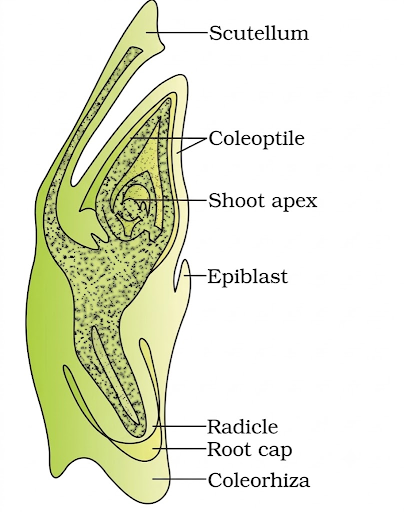
In grasses such as maize, the single cotyledon is called the scutellum. The plumule and radicle are protected by sheath-like structures.
The sheath which covers the plumule is called the coleoptile, while the sheath surrounding the radicle is called the coleorhiza.
Therefore, a typical monocot embryo contains:
- One cotyledon called the scutellum
- Embryonal axis
- Epicotyl
- Shoot apex
- Leaf primordia
- Coleoptile
- Radicle
- Root cap
- Coleorrhiza
The main difference can be remembered as:
Dicot embryo → Two cotyledons
Monocot embryo → One cotyledon
Difference Between Dicot & Monocot Embryo
| Feature | Dicot Embryo | Monocot Embryo |
|---|---|---|
| Cotyledons | Two | One |
| Cotyledon Name | Cotyledons | Scutellum |
| Shoot Apex | Plumule | Coleoptile (shoot protection) |
| Root Protection | Root cap | Coleorrhiza encloses radicle and root cap |
Development of the Seed
In angiosperms, the seed is the final product of sexual reproduction. It is often described as a fertilised ovule.
As the ovule matures, its integuments harden and form the protective seed coats. The micropyle remains as a small pore in the seed coat. It helps in the entry of oxygen and water during germination.
A typical seed contains:
- Seed coat
- Cotyledon(s)
- Embryonal axis
Types of Mature Seeds
Mature seeds can be classified based on whether they retain endosperm.
Non-Albuminous Seeds
In non-albuminous seeds, the endosperm is completely consumed during embryo development.
Examples include:
- Pea
- Groundnut
- Beans
Albuminous Seeds
In albuminous seeds, some endosperm remains in the mature seed.
Examples include:
- Wheat
- Maize
- Barley
- Castor
Perisperm
In some seeds, some parts of the nucellus remain even after the seed develops. This remaining nucellus is called the perisperm.
Examples:
- Black pepper
- Beetroot plant
Structure of a Dicot Seed
A mature dicot seed, such as a bean seed, contains a seed coat and an embryo. The seed coat protects the seed from damage and drying. It has a small scar called the hilum, which marks the point where the seed was attached to the funicle.
A small opening called the micropyle is also present near the hilum.
Inside the seed coat lies the embryo. The embryo has two cotyledons and an embryonal axis. The cotyledons may store food that supports the developing seedling during germination.
The basic structure is:
Seed coat → Protection
Cotyledons → Food storage
Embryonal axis → Plumule + Hypocotyl + Radicle
Structure of a Monocot Seed
A maize grain is a common example of a monocot seed.
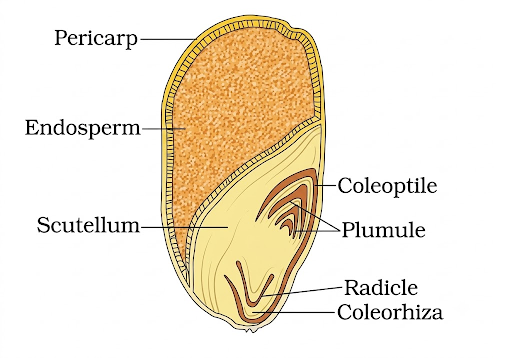
The seed contains a large endosperm that stores food. The embryo is located towards one side of the seed and contains a single cotyledon called the scutellum.
The plumule is protected by the coleoptile, while the radicle is protected by the coleorhiza. The outer covering of the maize grain is closely associated with the fruit wall, so the maize grain is technically a fruit called a caryopsis.
Seed Dormancy
As the seed matures, its water content decreases, and its metabolic activity slows down. The embryo may enter a state of inactivity called dormancy. When favourable conditions such as adequate moisture, oxygen, and suitable temperature are available, the seed can germinate.
Seed dormancy is important because it prevents immediate germination and allows mature seeds to remain viable until suitable conditions are available.
Formation of the Fruit
While the ovule develops into a seed, the ovary develops into a fruit. The wall of the ovary develops into the pericarp, which forms the fruit wall. The pericarp may be fleshy or dry depending on the type of fruit.
Thus:
Ovary → Fruit
Ovary wall → Pericarp
Ovule → Seed
Most fruits develop only from the ovary and are called true fruits.
However, in some plants, other floral parts also contribute to fruit formation. When the thalamus contributes to fruit formation along with the ovary, the fruit is called a false fruit.
Examples include:
- Apple
- Strawberry
- Cashew
Significance of Seed and Fruit Formation
The formation of seeds and fruits completes an important part of the reproductive cycle of flowering plants. The seed contains the embryo and allows the new plant to remain protected until suitable conditions for germination are available. Seeds can also help plants survive unfavourable conditions and spread to new places.
The fruit protects the developing seeds and, in many plants, helps in their dispersal. Therefore, post-fertilisation development does not simply produce a seed and fruit. It prepares the next generation of the plant for survival and growth.
Special Modes of Reproduction
The normal formation of seeds and fruits involves fertilisation. However, flowering plants can also show special reproductive processes in which the usual sequence is modified. Apomixis, parthenocarpy and polyembryony are important special modes associated with seed and fruit development.
From Fertilisation to Seed and Fruit
The entire process can now be connected as one continuous sequence:
Double fertilisation
↓
Zygote + Primary endosperm nucleus
↓
Embryo + Endosperm development
↓
Ovule develops into seed
↓
Ovary develops into fruit
↓
Mature seed and fruit
This sequence connects fertilisation with the formation of the next generation of flowering plants.
Important Points to Remember
- Post-fertilisation events begin after double fertilisation.
- The zygote develops into the embryo.
- The primary endosperm nucleus undergoes divisions and develops into the endosperm.
- The endosperm provides nourishment to the developing embryo.
- In a typical dicot embryo, there are two cotyledons.
- In a monocot embryo, there is one cotyledon called the scutellum.
- The plumule develops into the shoot system.
- The radicle develops into the root system.
- The integuments of the ovule develop into seed coats.
- The ovule develops into a seed.
- The ovary develops into a fruit.
- The ovary wall develops into the pericarp.
- A maize grain is a monocot seed and a caryopsis.
- Some fruits develop without fertilisation and are called parthenocarpic fruits.
- Apomixis, parthenocarpy and polyembryony are special reproductive processes found in flowering plants.
FAQs
Post-fertilisation events are the developmental changes that occur after fertilisation. They include the development of the embryo and endosperm, seed formation, and fruit formation.
After fertilisation, the zygote undergoes repeated cell divisions and develops into an embryo. The embryo later develops into a young plant.
The main function of the endosperm is to provide nourishment to the developing embryo. It stores food materials that are used by the embryo during its growth and development.
After fertilisation, the ovule develops into a seed. The seed contains the developing embryo along with stored food and protective coverings.
After fertilisation, the ovary develops into a fruit. The ovary wall becomes the pericarp, which forms the outer part of the fruit and helps protect the seeds.
A typical dicot embryo has two cotyledons, while a monocot embryo has only one cotyledon. In grasses, the single cotyledon is called the scutellum. The cotyledons help in supplying food to the developing embryo.
The coleoptile is a protective sheath that covers and protects the plumule in a monocot embryo. The coleorhiza is a protective sheath that covers and protects the radicle.
A parthenocarpic fruit is a fruit that develops without fertilisation. Such fruits usually do not contain seeds.
Examples include bananas and some varieties of grapes.
Seed formation is important because the seed protects the developing embryo from unfavourable conditions. It also helps the plant survive until the conditions become suitable for germination and growth.
After fertilisation, the zygote develops into the embryo, while the primary endosperm nucleus develops into the endosperm. The ovule develops into a seed, and the ovary develops into a fruit. The ovary wall develops into the pericarp, which forms the protective covering of the fruit.