

What Is Charles Law?
Charles’ Law states that the volume of a fixed mass of gas is directly proportional to its absolute temperature at constant pressure.
( മർദം സ്ഥിരമായിരിക്കുമ്പോൾ, ഒരു നിശ്ചിത മാസ്സ് വാതകത്തിന്റെ വ്യാപ്തം കെൽവിൻ സ്കെയിലിലെ താപനിലയ്ക്ക് നേർഅനുപാതത്തിലായിരിക്കും. ഇതാണ് ചാൾസ് നിയമം.)
Charles’s Law: Relation Between Volume and Temperature
The volume of a gas also changes when its temperature changes.
Consider a bottle containing air and a small amount of ink in a refill fixed through the bottle cap. The ink acts like a movable indicator. When the bottle is warmed by holding it with the palms, the air inside gets heated. The gas expands, pushing the ink upward. When the bottle is cooled, the gas contracts and the ink moves downward.
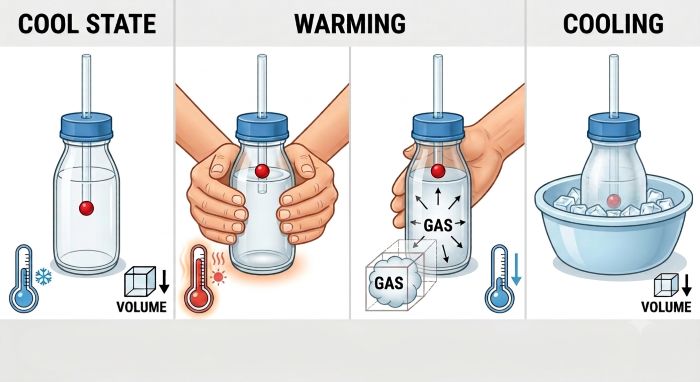
This shows that the volume of a gas changes with temperature when pressure remains constant.
Volume–Temperature (V–T) Graph
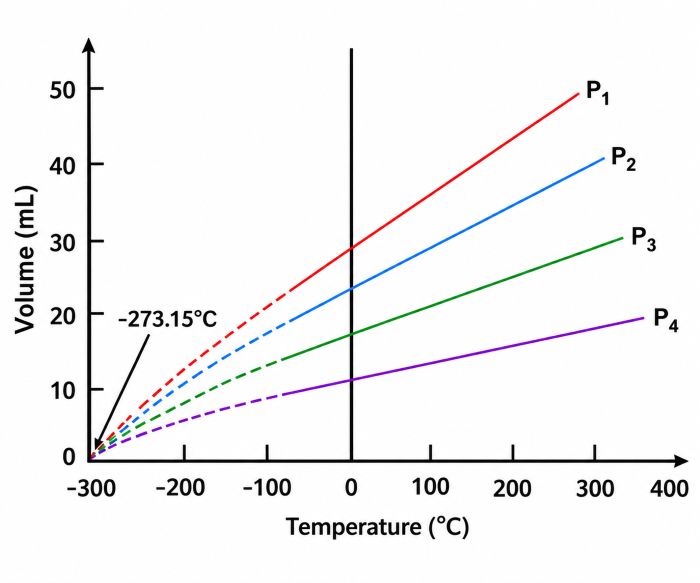
The graph shows the relationship between the volume and temperature of a definite mass of gas at different pressures.
Temperature is shown on the X-axis and volume on the Y-axis.
The straight lines P₁, P₂, P₃ and P₄ represent different pressures.
At constant pressure, volume increases with an increase in temperature.
When the lines are extended backwards, they meet the temperature axis at about −273.15°C, called absolute zero.
Thus, at constant pressure, the volume of a definite mass of gas is directly proportional to its temperature in the Kelvin scale. This is Charles’s Law.
Ready to Score Better in Your SSLC Exams?
Prepare well for your SSLC exams with Xylem Online Tuition. Learn your subjects easily and get ready to score better.
Register NowWhat Happens When Temperature Increases?
At constant pressure, heating a gas causes its volume to increase. Cooling the gas causes its volume to decrease.
The relationship between the volume and temperature of gases was studied by Jacques Alexandre Cesar Charles, a French scientist.
Absolute Zero and Kelvin Scale
When the volume-temperature graph is extended backward, it meets the temperature axis at about −273.15°C.
- This temperature is called absolute zero.
- For practical calculations, absolute zero is commonly taken as approximately −273°C.
- The Kelvin scale is used when applying Charles’s Law.
The relationship between Celsius and Kelvin temperature is:
T(K) = t(°C) + 273
Statement of Charles’s Law
At constant pressure, the volume of a fixed mass of gas is directly proportional to its temperature in Kelvin.
V ∝ T (pressure, mass constant) V = k × T (k – a constant)
According to Charles’ Law, at constant pressure, the volume of a fixed amount of gas is directly proportional to its absolute temperature.
This can be written as:
V ∝ T
Since volume and temperature are directly proportional,
V = kT where k is a constant.
Rearranging,
V T = k
Consider the initial volume and temperature of a gas as V₁ and T₁.
V₁ T₁ = k
When the temperature changes to T₂, the volume changes to V₂.
V₂ T₂ = k
Therefore,
V₁ T₁ = V₂ T₂
Applications of Charles’s Law
The effect of temperature on the volume of gases can be observed in everyday situations.
1. Vehicle tyres: During summer, the temperature of air inside vehicle tyres increases. Therefore, tyres are filled with air at a lower pressure.
2. Inflated balloons: When an inflated balloon is kept in sunlight, the air inside it gets heated. Its volume increases, causing the balloon to expand and possibly burst.
Charles’s Law makes it easier to understand how gases respond to changes in temperature. By learning its formula, examples, and applications, the concept of gas behaviour becomes clearer and easier to apply in Gas Laws and Mole Concept.
FAQ’s
Charles’s Law states that at constant pressure, the volume of a fixed mass of gas is directly proportional to its temperature in Kelvin.
The formula is V/T = k. For two different conditions, it can be written as V₁/T₁ = V₂/T₂.
At constant pressure, the volume of a fixed mass of gas increases when its temperature increases. When the temperature decreases, its volume decreases.
The Kelvin scale is used because Charles’s Law relates gas volume to absolute temperature. The temperature can be converted using T(K) = t(°C) + 273.
Absolute zero is approximately −273.15°C, the temperature at which the volume of a gas is theoretically considered to become zero when the volume–temperature relationship is extrapolated.
Charles’s Law can be observed in situations such as the expansion of air in an inflated balloon when heated and changes in the volume of gases with temperature.