

The science that deals with the study of the combined effects of both heat and work, along with changes of state, is known as thermodynamics.
It helps to understand the behavior of matter on a large scale, without needing to look at the motion of individual particles. Essentially, thermodynamics explains how energy drives changes in the world around us.
We have created Class 11 Thermodynamics study notes to help students understand the topics of thermodynamics in a better and more detailed way.
System and Surroundings
The “system” refers to everything contained within the boundary, and the “surroundings” refers to everything outside of it. Once the boundary diagram has been created, the flow across system boundaries can be used to describe the movement and transfer of energy. Eventually, the system and surroundings combine to form the Universe.
System
It consists of a definite quantity of matter or a region in space separated from the rest of the universe by a boundary. This boundary may be real or imaginary, and it can be either fixed or movable depending on the situation. Everything outside the system is considered the surroundings.
Based on the exchange of matter and energy, systems are classified into three types, and they are as follows
- Open System: An open system is one that can exchange both matter and energy with its surroundings. Mass and energy can enter or leave the system.
- Closed System: A closed system can exchange energy with its surroundings but cannot exchange matter. Energy may cross the boundary, but mass remains constant within the system.
- Isolated System: An isolated system is a system that neither exchanges matter nor energy with its surroundings. It is completely sealed and perfectly insulated, so no heat or mass can enter or leave.
Surroundings
The surroundings refer to everything outside the system that can interact with it or influence its behavior. In simple words, whatever is not part of the system but can affect it is called the surroundings.
The system and its surroundings together form the universe. For practical purposes, surroundings usually mean the nearby region around the system that can exchange energy or matter with it.
Prepare Smarter Today for a Successful Academic Year!
Join Xylem Online Tuition to understand your lessons better, keep up with your syllabus, and feel confident for your annual exams.
Register NowThermodynamics
- Classical Thermodynamics: The behavior of matter using a macroscopic approach. It deals with bulk properties such as temperature, pressure, and volume to analyze systems and predict their behavior during physical or chemical processes.
- Statistical Thermodynamics: Every molecule is in the spotlight in statistical thermodynamics, which means that the properties of each molecule and how they interact are taken into account to characterize the behavior of a group of molecules.
- Chemical Thermodynamics: Chemical thermodynamics studies heat and work changes during chemical reactions and phase transitions.
- Equilibrium Thermodynamics: Equilibrium thermodynamics focuses on the study of systems in equilibrium and the energy and matter changes as systems approach equilibrium.
Thermodynamic Properties
Thermodynamic properties are the characteristics of a system that describe its state. They are classified into two categories:
- Extensive property: Extensive properties depend on the amount or size of the substance present in the system. Their values change when the mass of the system changes. Eg: internal energy, entropy, enthalpy, free energy, volume, and mass.
- Intensive property: Intensive properties are independent of the amount or size of the substance present. Their values remain the same regardless of the system’s mass. Eg: temperature, pressure, density, viscosity, surface tension, and vapor pressure.
State and Path functions
- A function or a property that depends only on the initial and final state of a system and not on the path followed is known as a state function. E.g., temperature (T), pressure (p), volume (V), internal energy (U), enthalpy (H), entropy (S), Gibb’s energy (G).
- Path functions: These are properties that depend on the path followed also. E.g heat (q) and work (w).
Heat and Work
1. Heat
It is a form of energy. Heat flows from a hot body to a cold body when there is a thermal contact between the two. When a body absorbs heat, its energy increases, and when it evolves heat, its energy decreases. Thus, by international convention, when heat is absorbed by a system, q becomes +ve, and when heat is evolved by a system, q becomes –ve.
2. Work
There are two types of work: expansion work and non-expansion work.
1. Expansion work (wexp): It is related to gaseous systems. It is the product of pressure (p) and change in volume (ΔV).
Note: For an irreversible process, wexp = -pΔV
and for a reversible process, wexp = -2.303nRT log V2 V1 .
2. Non-expansion work: It is related to electrochemical cells. It is the product of potential difference (E) and charge (Q), i.e., wnon-exp = E × Q.
By international convention, w becomes +ve when work is done on the system, and w becomes −ve when work is done by the system.
Internal Energy (U)
Every body is associated with a definite amount of energy. This energy is called internal/intrinsic energy. It is the energy possessed by a body. It is the sum of different types of molecular energies like translational kinetic energy, rotational kinetic energy, vibrational kinetic energy, electronic energy, nuclear energy, etc. We cannot calculate the exact value of internal energy, but we can calculate the change in internal energy (ΔU) during a process by using an apparatus called Bomb Calorimeter.
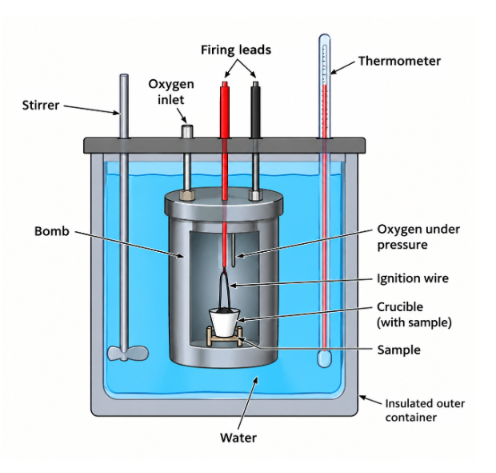
The change in internal energy (ΔU) = U2 − U1, where U1 and U2 are the initial and final internal energies, respectively.
The SI unit of internal energy is the joule (J). It may also be expressed in kJ.
The internal energy of a system can be changed in the following ways:
1. By the transfer of heat into or out of the system
2. By work done on or by the system
3. By the transfer of matter into or out of the system.
Thermodynamic Equilibrium
All properties of a system have fixed values at any given state. As a result, even if the value of one property changes, the state of the system changes. But when a system is in equilibrium, the value of its properties does not change when it is isolated from its surroundings.
To prove this, thermodynamic equilibrium is categorised into the following:
- Thermal equilibrium: A system is said to be in thermal equilibrium when the temperature is the same throughout the entire system.
- Mechanical equilibrium: A system is said to be in mechanical equilibrium when there is no change in pressure at any point in the system.
- Chemical equilibrium: A chemical equilibrium is defined as a system in which the chemical composition of a system does not change over time.
- Phase equilibrium: When the mass of each phase of a two-phase system reaches an equilibrium level, it is called phase equilibrium.
Thermodynamic Process
A process can alter the state of a thermodynamic system. A process, in other words, specifies the path or procedure by which a system transitions from one state to another. The process may be accompanied by a material and energy exchange between the system and the surroundings.
When there is an energetic shift within a system that is related to changes in pressure, volume, and internal energy, it is called a thermodynamic process.
Some characteristics of thermodynamic processes are listed below:
- Isothermal process: A process in which the temperature remains constant throughout. Heat is exchanged with the surroundings to maintain constant temperature.
- Adiabatic process: A process in which no heat is exchanged between the system and its surroundings. The system is thermally insulated, and the temperature usually changes during the process.
- Isobaric process: A process in which the system’s pressure remains constant, i.e., no pressure change occurs.
- Isochoric process: A process in which the volume of the system remains constant, i.e., there is no change in volume and no work is done by the system.
- Reversible process: A process that can be reversed by making an infinitesimally small change in external conditions. The system remains in equilibrium with its surroundings at every stage of the process.
- Irreversible process: A process that cannot be reversed so that both the system and surrounding are restored exactly to their initial state is known as an irreversible process. The opposing force is not the same as the driving force. Natural processes are irreversible.
- Cyclic process: A process in which the system undergoes a series of changes and eventually returns to its initial state.
FAQ's
Thermodynamics is the study of heat, work, energy, and their changes during physical and chemical processes.
The system is the part of the universe being studied, while the surroundings include everything outside the system that can interact with it.
Thermodynamic systems are classified as open, closed, and isolated systems based on their exchange of matter and energy.
Intensive properties do not depend on the amount of substance, whereas extensive properties depend on the amount of substance present.
A state function is a property that depends only on the initial and final states of a system, not on the path followed.
Heat is energy transferred because of a temperature difference, while work is energy transferred when a force causes a displacement or through other forms of energy transfer.
Internal energy (U) is the total energy associated with the microscopic motions and interactions of the particles within a system.