

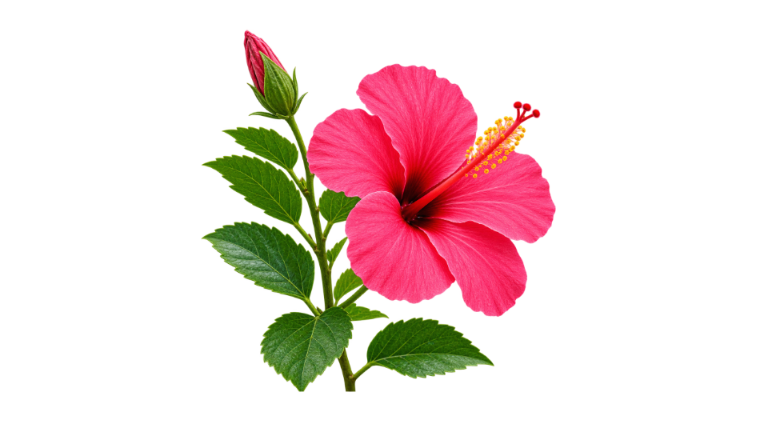
We see a huge variety of plants all around us. Despite this, the fact is that they share fundamental structural plans and basic physiological functions, even though they appear with different types of roots, stems, leaves, flowers, fruits, seeds, etc. During this time period, plants have evolved into a number of species, with each one having its own characteristic features. The last to evolve among these are the angiosperms, or the Flowering Plants. So, here we have included all the important topics associated with the Class 11 Botany 6th chapter, Anatomy of Flowering Plants. Hope this helps you to learn well.
What is Plant Anatomy?
Basically, Anatomy is the branch of biology concerned with the study of the internal structures or organ systems of an organism. When it comes to plants, it is the study of the internal structure of a plant, including the tissues, root system, stem, leaves, flower, fruit, and seeds.
Cell ⟶ Tissue ⟶Tissue system ⟶Organ⟶ Plant
Importance of plant anatomy
- Helps understand the internal structure and organisation of plant organs.
- Explains how different tissues perform specific functions.
- Helps identify anatomical differences between monocot and dicot plants.
- Helps understand how plants adapt to different environmental conditions
Now let’s learn more about the plant’s structure:
Cell: A plant cell is the basic structural and functional unit of a plant. It contains a cell wall, cell membrane, nucleus, cytoplasm, and other organelles. It generally contains chloroplasts for photosynthesis in green tissues and a large central vacuole.
Tissue: It is a cluster of cells that are similar in configuration and work together to attain a specific function. Different types of plant tissues include permanent and meristematic tissues.
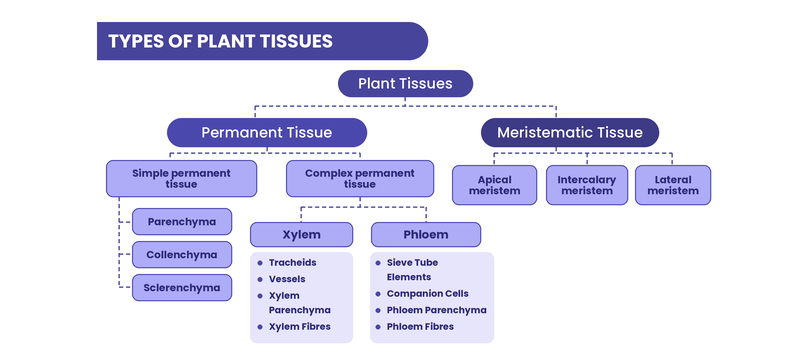
1.Permanent tissues
These cells are used to provide elasticity, flexibility, and strength to the plant. These tissues can be categorised into:
- Simple Permanent Tissue
They can be classified into parenchyma, collenchyma, and sclerenchyma based on their purpose. Provides structural assistance to the stem and assists in storing water and sugars.
- Parenchyma
These are living, polygonal cells with a big central vacuole and have intercellular spaces in them. Parenchymatous cells create ground tissue and pith.
NOTE:
- Parenchyma with chloroplasts is called chlorenchyma. The chlorenchyma helps in photosynthesis.
- A parenchyma that consists of large air spaces is called aerenchyma. Buoyancy is the main purpose of aerenchyma.
- Some parenchymatous cells perform as storage chambers for starch in vegetables and fruits.
Collenchyma
These are living cells with minute intercellular gaps. Their cell walls are made up of pectin, cellulose, and hemicellulose, with uneven thickening particularly at the corners. Collenchyma is found in the marginal regions of leaves and stems and offers flexibility with the structural framework and mechanical support to plants.
Sclerenchyma
Sclerenchyma consists of dead cells with thick lignified cell walls. It includes two types of cells: fibres and sclereids. Fibres are generally elongated, whereas sclereids vary in shape. Intercellular spaces are generally absent. Sclerenchyma is found in the covering of seeds and nuts, around the vascular tissues in stems, and the veins of leaves. Sclerenchyma provides strength to the plant.
Ready to Score Better in Your PLUS ONE Exam?
Get ready for your Plus One exams with Xylem Online Tuition and build a strong foundation for your future.
Register Now2. Complex Permanent Tissue
Involved in the transportation of minerals, water, and sugars to various plant parts. These tissues include phloem and xylem.
Xylem
It helps in the transport of dissolved substances and water throughout the plant. The diverse components of the xylem include vessels, tracheids, xylem fibres, and xylem parenchyma. Xylem fibres and tracheids have lignified secondary walls, which provide structural support to the plant.
Phloem
This tissue helps in the transportation of food throughout the plant. The diverse elements of phloem include phloem fibres, sieve tubes, phloem parenchyma, and companion cells.
The Tissue System
1. Epidermal Tissue
- The epidermal tissue system forms the outermost covering of the plant body. It comprises special, flattened cells, polygonal in shape.
This tissue covers leaves and stems with a waxy cuticle, preventing evaporative loss of water.
They protect and cover the plant, regulating the exchange of gases and absorption of water.
It consists of:
- Epidermis
- Stomata
- Epidermal appendages, such as trichomes and root hairs
A. Epidermis
The epidermis is the outermost layer of the primary plant body.
Characteristics:
- Usually consists of a single layer of compactly arranged cells.
- Cells are generally elongated and closely packed.
- The outer surface is often covered by a waxy layer called the cuticle.
- The cuticle reduces water loss through transpiration.
- The cuticle is absent in the roots.
B. Stomata
Stomata are small pores present in the epidermis of leaves that regulate gaseous exchange and transpiration.
Functions of stomata:
- Regulate transpiration.
- Facilitate gaseous exchange.
- Help in regulating water balance in the plant
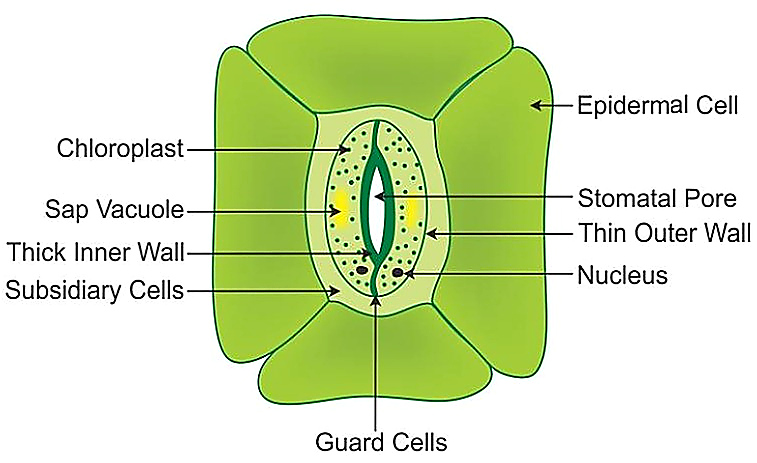
Structure of a stomata
- Each stoma consists of two specialised guard cells surrounding a stomatal pore.
- Guard cells are bean-shaped in most plants.
- In grasses, guard cells are dumbbell-shaped.
- Guard cells contain chloroplasts.
- The inner walls of guard cells, facing the pore, are thick, while the outer walls are thinner.
- Specialised epidermal cells surrounding guard cells are called subsidiary cells.
Stomatal apparatus: The stomatal pore, guard cells, and surrounding subsidiary cells together form the stomatal apparatus.
C. Root Hairs
Root hairs are unicellular extensions of epidermal cells in roots.
Functions:
- Absorb water from the soil.
- Absorb dissolved minerals.
- Increase the surface area available for absorption.
D. Trichomes
Trichomes are epidermal hairs found mainly on the stem and other aerial parts of plants.
Characteristics:
- Usually multicellular in the shoot system.
- May be branched or unbranched.
- May be soft or stiff.
- Some trichomes are secretory.
Functions:
- They help to reduce water loss through transpiration.
- May perform protective or secretory functions
Ground Tissue System
All tissue except epidermis and vascular bundle constitute the ground tissue
Mesophyll
Mesophyll is the ground tissue of the leaf, consisting of thin walled, chloroplast containing cells. The main function of Mesophyll is that it carries out photosynthesis.
- In grasses, certain adaxial epidermal cells along the veins become large, empty and colourless.
- These cells are called bulliform cells.
Role of bulliform cells:
- When bulliform cells absorb water and become turgid, the leaf surface is exposed.
- When they become flaccid due to water stress, the leaves curl inward.
- This inward curling helps minimise water loss.
Vascular Tissue System
Types of vascular bundles
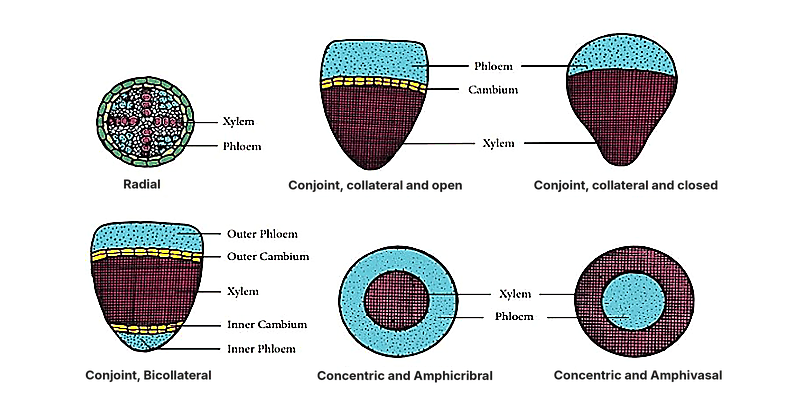
Vascular bundles are classified based on the arrangement of xylem and phloem and the presence or absence of cambium.
A. Radial vascular bundles
- Xylem and phloem are arranged alternately along different radii.
- Commonly found in roots.
B. Conjoint vascular bundles
- Xylem and phloem are situated together along the same radius.
- Commonly found in stems and leaves.
C. Open vascular bundles
- Cambium is present between xylem and phloem.
- Cambium can produce secondary xylem and secondary phloem.
- Commonly found in dicot stems.
D. Closed vascular bundles
- Cambium is absent between xylem and phloem.
- These bundles do not form secondary vascular tissues.
- Commonly found in monocot stems.
- In dicot leaves the size of the vascular bundles are dependent on the size of the veins.
- The parallel venation in monocot leaves is reflected in the near similar sizes of vascular bundles(except in main veins) as seen in vertical sections of the leaves.
FAQ's
Epidermal tissue forms the outermost covering of the plant body and includes the epidermis, stomata, and epidermal appendages such as root hairs and trichomes.
Stomata are small pores in the epidermis of leaves that regulate gaseous exchange and transpiration. They also help regulate the water balance of the plant.
The three types of simple permanent tissues are parenchyma, collenchyma, and sclerenchyma.
Xylem and phloem are complex permanent tissues. Xylem transports water and dissolved substances, while phloem transports food throughout the plant.
The main types of vascular bundles are radial, conjoint, open, and closed vascular bundles, based on the arrangement of xylem and phloem and the presence or absence of cambium.
Open vascular bundles have cambium between xylem and phloem and can form secondary vascular tissues, whereas closed vascular bundles lack cambium and do not form secondary vascular tissues.