

They are two major groups of flowering plants, classified mainly based on the number of cotyledons (seed leaves) present in their seeds.
1. Dicotyledonous plants
Dicotyledonous plants (dicots) have two cotyledons in their seeds.
Examples: Pea, gram, bean, sunflower, mango.
Common features:
- Two cotyledons in the seed
- Usually reticulate (net-like) venation in leaves
- The root system is generally the taproot system.
- Vascular bundles in the stem are generally arranged in a ring
2. Monocotyledonous plants
Monocotyledonous plants (monocots) have one cotyledon in their seeds.
Eg: Maize, wheat, rice, grass, lily.
Common features:
- One cotyledon in the seed
- Usually parallel venation in leaves
- The root system is generally a fibrous system.
- Floral parts are commonly in multiples of 3
- Vascular bundles in the stem are generally scattered
Dicotyledonous root
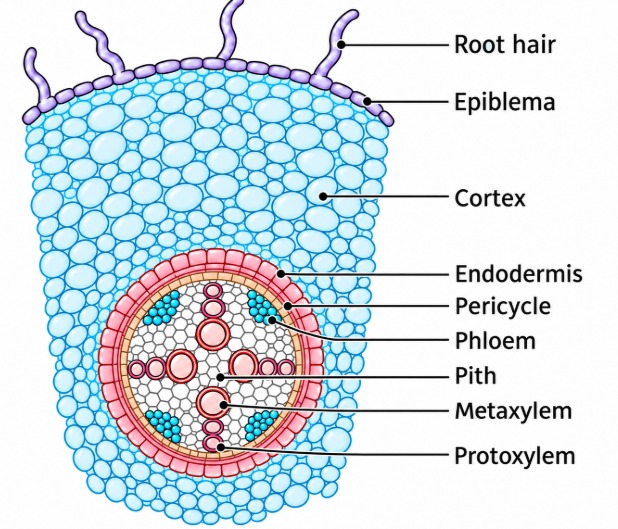
It mainly consists of the following elements:
1. Epiblema
- It is the outermost layer of the root.
- Many epiblema cells extend outward to form unicellular root hairs.
2. Cortex
- Consists of several layers of thin-walled parenchymatous cells.
- Intercellular spaces are present between the cells.
3. Endodermis
- It is the innermost layer of the cortex.
- Consists of a single layer of barrel – shaped cells.
- Intercellular spaces are absent.
- The radial and tangential walls contain a deposition of suberin, a water – impermeable, waxy material.
- This deposition forms Casparian strips.
4. Pericycle
- Located next to the endodermis.
- Consists of a few layers of thick-walled parenchymatous cells.
- Lateral roots and vascular cambium during secondary growth originate from these cells.
5. Vascular tissues
- Xylem and phloem are arranged in separate patches.
- Usually, two to four xylem and phloem patches are present.
- Parenchymatous cells between the xylem and phloem are called conjunctive tissue.
- A cambium ring develops between the xylem and phloem later.
6. Pith
The pith is small or inconspicuous.
7. Stele
All tissues inside the endodermis, including the pericycle, vascular bundles, and pith, together form the stele.
Ready to Score Better in Your SSLC Exams?
Prepare well for your SSLC exams with Xylem Online Tuition. Learn your subjects easily and get ready to score better.
Register NowMonocotyledonous Root
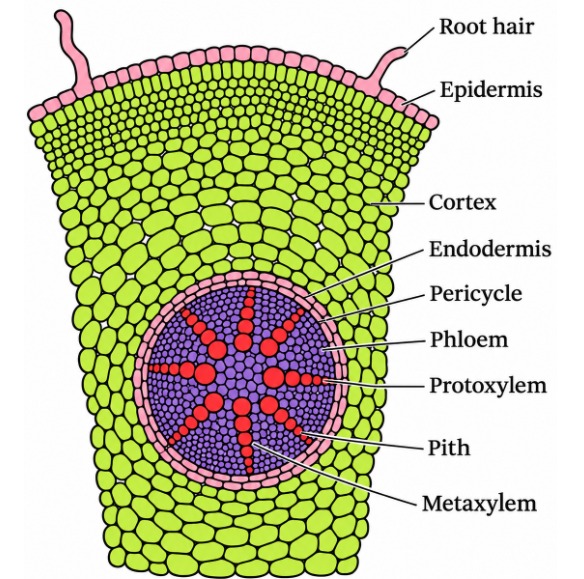
The main characteristics of a monocotyledonous root are as follows:
- It has an epidermis, cortex, endodermis, pericycle, vascular bundles, and pith.
- It usually has more than six xylem bundles. This condition is called polyarch.
- The pith is large and well-developed.
- Monocot roots do not undergo secondary growth.
Dicotyledonous Stem
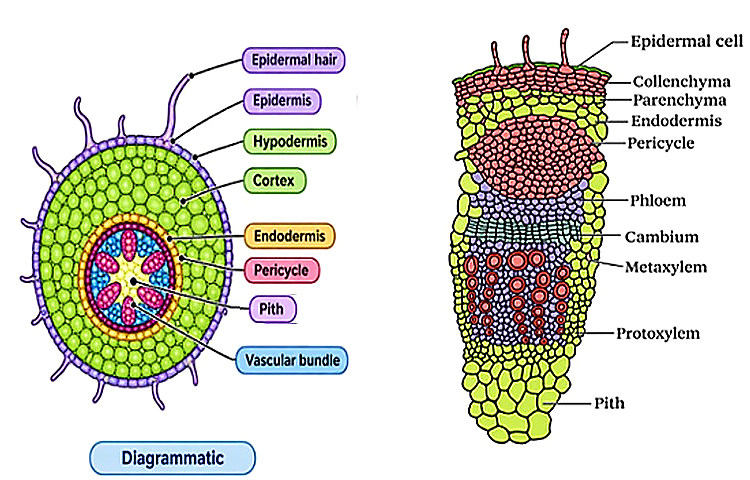
The transverse section of a typical young dicotyledonous stem shows the following structures.
1. Epidermis
- It is the outermost protective layer of the stem.
- It is covered by a thin cuticle.
- It may bear trichomes and a few stomata.
2. Cortex
The cortex consists of cells arranged in multiple layers between the epidermis and pericycle. It is divided into three sub-zones.
a. Hypodermis
- Located just below the epidermis.
- Consists of a few layers of collenchymatous cells.
- Provides mechanical strength to the young stem.
b. Cortical layers
- Located below the hypodermis.
- Consists of rounded, thin walled parenchymatous cells.
- Intercellular spaces are conspicuous.
c. Endodermis
- It is the innermost layer of the cortex.
- The cells contain abundant starch grains.
- This layer is also called the starch sheath.
3. Pericycle
- Located on the inner side of the endodermis and above the phloem.
- Present as semi-lunar patches of sclerenchyma.
4. Medullary rays
- Consist of a few layers of radially arranged parenchymatous cells.
- Located between the vascular bundles.
5. Vascular bundles
- A large number of vascular bundles are arranged in a ring.
- The ring arrangement is characteristic of a dicot stem.
- Each vascular bundle is conjoint and open.
- Protoxylem is endarch.
6. Pith
- Occupies the central portion of the stem.
- Consists of rounded, parenchymatous cells.
- Large intercellular spaces are present.
Monocotyledonous Stem
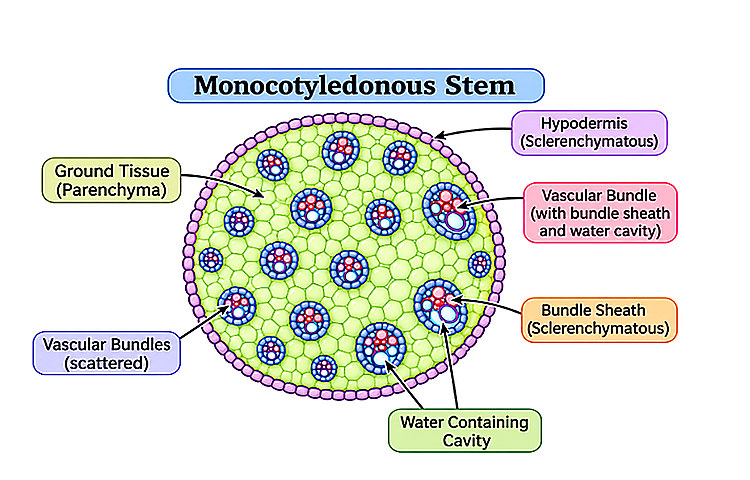
The monocot stem has the following anatomical characteristics.
1. Hypodermis
The hypodermis is sclerenchymatous.
2. Ground tissue
A large, conspicuous parenchymatous ground tissue occupies the stem.
3. Vascular bundles
Numerous vascular bundles are scattered throughout the ground tissue.
- Each vascular bundle is surrounded by a sclerenchymatous bundle sheath.
- The vascular bundles are conjoint and closed.
- Peripheral vascular bundles are generally smaller than those located centrally.
4. Phloem
Phloem parenchyma is absent.
5. Water containing cavities
Water containing cavities are present within the vascular bundles.
Dicotyledonous Leaf
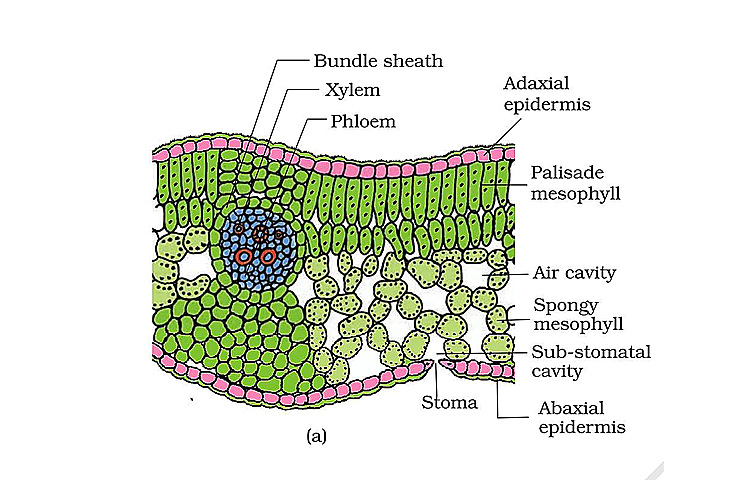
Vertical section of a dorsiventral leaf through the lamina shows three main parts:
- Epidermis
- Mesophyll
- Vascular system
1. Epidermis
The epidermis covers both the upper and lower surfaces of the leaf.
- Adaxial epidermis: The upper surface of the leaf.
- Abaxial epidermis: The lower surface of the leaf.
- Both surfaces have a conspicuous cuticle.
- The lower epidermis generally bears more stomata than the upper epidermis.
2. Mesophyll
Mesophyll is the tissue present between the upper and lower epidermis.
Characteristics:
- Contains chloroplasts.
- Carries out photosynthesis.
- Consists of parenchymatous cells.
- Is differentiated into palisade parenchyma and spongy parenchyma.
A. Palisade parenchyma
- Located towards the upper or adaxial side.
- Consists of elongated cells.
- Cells are arranged vertically and parallel to one another.
B. Spongy parenchyma
- Located below the palisade cells.
- Consists of oval or rounded cells.
- Cells are loosely arranged.
- Extends towards the lower epidermis.
- Numerous large spaces and air cavities are present between the cells.
3. Vascular system
- Consists of vascular bundles present in the veins and midrib.
- The size of vascular bundles depends on the size of the veins.
- Veins vary in thickness in the reticulate venation of dicot leaves.
- Vascular bundles are surrounded by a layer of thick-walled bundle sheath cells.
Isobilateral (Monocotyledonous) Leaf
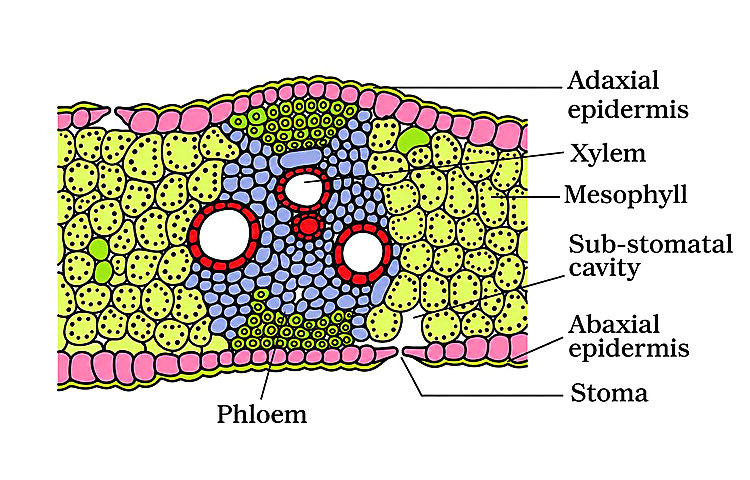
The anatomy of an isobilateral leaf is similar to that of a dorsiventral leaf in many ways, but it has the following characteristic differences.
1. Stomata
Stomata are present on both surfaces of the epidermis.
2. Mesophyll
Mesophyll is not differentiated into palisade and spongy parenchyma.
3. Bulliform cells
In grasses, certain adaxial epidermal cells along the veins become large, empty, and colourless. These cells are called bulliform cells.
Role of bulliform cells:
- When bulliform cells absorb water and become turgid, the leaf surface is exposed.
- When they become flaccid due to water stress, the leaves curl inward.
- This inward curling helps minimise water loss.
4. Vascular bundles
- Parallel venation is reflected in the nearly similar sizes of vascular bundles.
- The main veins are exceptions to this general pattern.
FAQ's
Dicotyledonous plants are flowering plants that have two cotyledons in their seeds. Pea, gram, bean, sunflower, and mango are examples.
Dicotyledonous plants are flowering plants that have two cotyledons in their seeds. Pea, gram, bean, sunflower, and mango are examples.
Dicots generally have two cotyledons, reticulate venation, tap roots, and vascular bundles arranged in a ring, while monocots generally have one cotyledon, parallel venation, fibrous roots, and scattered vascular bundles in the stem.
The endodermis is the innermost layer of the cortex and contains Casparian strips formed by suberin deposition in the radial and tangential walls.
In monocotyledonous roots, the presence of more than six xylem bundles is called the polyarch condition.
The vascular bundles in a dicotyledonous stem are arranged in a ring. They are conjoint and open, with protoxylem being endarch.
A monocotyledonous stem has a sclerenchymatous hypodermis, large parenchymatous ground tissue, and numerous vascular bundles scattered throughout the ground tissue. The vascular bundles are conjoint and closed.
A dorsiventral dicot leaf has mesophyll differentiated into palisade and spongy parenchyma, while an isobilateral monocot leaf has undifferentiated mesophyll and generally has stomata on both surfaces.