

Isomerism is an important concept in coordination chemistry. Some coordination compounds have the same chemical formula but differ in the arrangement of atoms or ligands. These compounds are called isomers, and the phenomenon is known as isomerism.
Even though isomers have the same chemical formula, they may show different physical and chemical properties because their structures or spatial arrangements are different.
For example, two coordination compounds may contain the same metal ion and ligands but differ in the positions of the ligands around the central metal ion.
What Are the Types of Isomerism in Coordination Compounds?
Isomerism in coordination compounds is broadly classified into two main types:
- Structural Isomerism
- Stereoisomerism
Classification of Isomerism
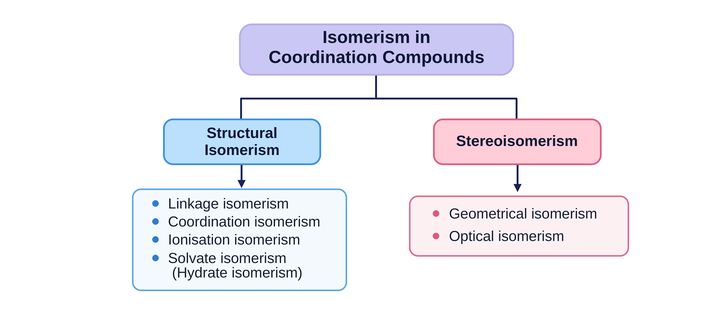
Structural isomers differ in the way atoms or groups are connected. Stereoisomers have the same chemical bonds but differ in the spatial arrangement of ligands.
1. Structural Isomerism in Coordination Compounds
Structural isomerism occurs when coordination compounds have the same chemical formula but differ in the arrangement or connectivity of ligands and ions.
There are four important types of structural isomerism.
Linkage Isomerism
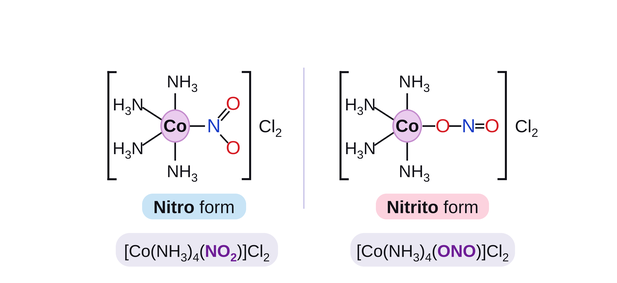
Linkage isomerism occurs when a coordination compound contains an ambidentate ligand that can coordinate with the central metal ion through two different donor atoms. An ambidentate ligand has two possible donor atoms, but it coordinates through only one donor atom at a time.
Example: Nitrite ion (NO₂⁻)
The nitrite ion can coordinate with the central metal ion through either nitrogen or oxygen.
- Through nitrogen: M – NO₂ (nitro form)
- Through oxygen: M – ONO (nitrito form)
For example, the following two complexes show linkage isomerism:
- [Co(NH₃)₅(NO₂)]Cl₂ – Nitrogen-bonded form
- [Co(NH₃)₅(ONO)]Cl₂ – Oxygen-bonded form
Both compounds have the same chemical composition, but the nitrite ligand attaches to cobalt through different donor atoms.
Another example: Thiocyanate ion (SCN⁻)
The thiocyanate ion can coordinate through:
- Nitrogen: M-NCS
- Sulphur: M-SCN
This also results in linkage isomerism.
Remember: Linkage isomerism is possible only when an ambidentate ligand is present.
Coordination Isomerism
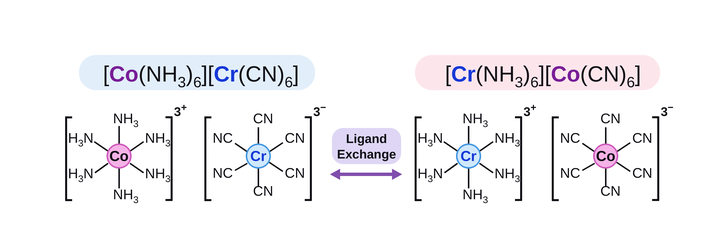
Coordination isomerism occurs in compounds containing both a complex cation and a complex anion. It arises due to the interchange of ligands between the two coordination entities.
Example:
The following two compounds show coordination isomerism:
- [Co(NH₃)₆][Cr(CN)₆]
- [Cr(NH₃)₆][Co(CN)₆]
In the first compound:
- NH₃ ligands are attached to Co³⁺
- CN⁻ ligands are attached to Cr³⁺
In the second compound:
- NH₃ ligands are attached to Cr³⁺
- CN⁻ ligands are attached to Co³⁺
The ligands are exchanged between the two metal ions, resulting in coordination isomerism.
Remember: Coordination isomerism occurs when both the cationic and anionic parts contain complex ions.
Ready to Score Better in Your Class 12 Exams?
Join Xylem Online Tuition and learn your subjects step by step, with simple explanations and regular practice.
Register NowIonisation Isomerism
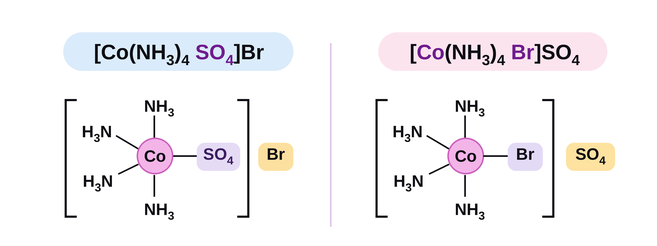
Ionisation isomerism occurs when a ligand inside the coordination sphere and a counter ion outside the coordination sphere exchange their positions. As a result, the isomers produce different ions when dissolved in water.
Example:
The following compounds show ionisation isomerism:
- [Co(NH₃)₅SO₄]Br
- [Co(NH₃)₅Br]SO₄
In the first compound:
- SO₄²⁻ is present inside the coordination sphere.
- Br⁻ is present outside the coordination sphere.
In the second compound:
- Br⁻ is present inside the coordination sphere.
- SO₄²⁻ is present outside the coordination sphere.
Therefore, both compounds produce different ions in aqueous solution.
Remember: Ionisation isomers give different ions when dissolved in water.
Solvate Isomerism (Hydrate Isomerism)
Solvate isomerism occurs when solvent molecules are present in different positions in coordination compounds. The solvent molecules may be directly attached to the central metal ion as ligands or may be present outside the coordination sphere.
When the solvent involved is water, this type of isomerism is called hydrate isomerism.
Example:
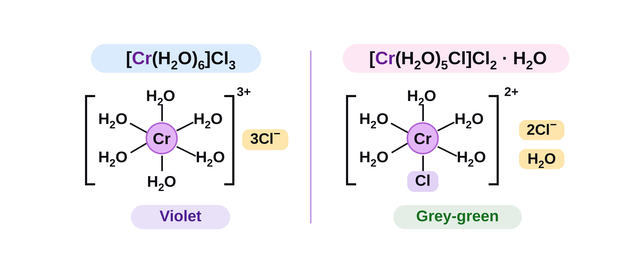
Chromium(III) chloride forms different hydrate isomers:
- [Cr(H₂O)₆]Cl₃ – Violet
- [Cr(H₂O)₅Cl]Cl₂·H₂O – Grey-green
In the first compound:
- Six water molecules are directly attached to the chromium ion.
- Three chloride ions are outside the coordination sphere.
In the second compound:
- Five water molecules and one chloride ion are attached to chromium.
- Two chloride ions and one water molecule are outside the coordination sphere.
The compounds have the same overall composition but differ in the distribution of water molecules and chloride ions.
Remember: Hydrate isomerism is a type of solvate isomerism in which water acts as the solvent.
2. Stereoisomerism in Coordination Compounds
Stereoisomerism occurs when coordination compounds have the same chemical formula and the same bonding arrangement but differ in the spatial arrangement of ligands around the central metal ion.
There are two main types:
- Geometrical Isomerism
- Optical Isomerism
Geometrical Isomerism
Geometrical isomerism occurs when ligands are arranged differently around the central metal ion. It is commonly observed in square planar and octahedral coordination compounds.
The two important forms of geometrical isomerism are:
- Cis-isomer
- Trans-isomer
Cis-Trans Isomerism in Square Planar Complexes
In square planar complexes, geometrical isomerism is possible when two different types of ligands are present.
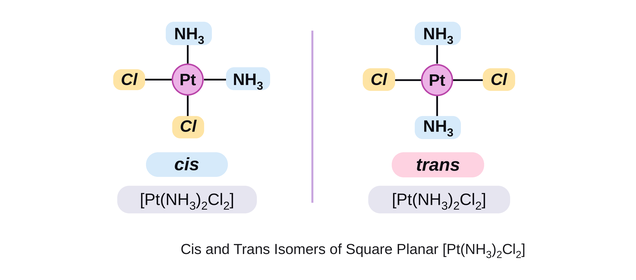
Example: [Pt(NH₃)₂Cl₂]
This complex exists in two geometrical forms:
- Cis-isomer
When two identical ligands occupy adjacent positions, the arrangement is called the cis-isomer. In cis-[Pt(NH₃)₂Cl₂], the two chloride ligands are adjacent to each other, with a bond angle of 90°.
- Trans-isomer
When two identical ligands occupy opposite positions, the arrangement is called the trans-isomer. In trans-[Pt(NH₃)₂Cl₂], the two chloride ligands are opposite to each other, with a bond angle of 180°.
Cis-Trans Isomerism in Octahedral Complexes
Geometrical isomerism is also observed in octahedral complexes.
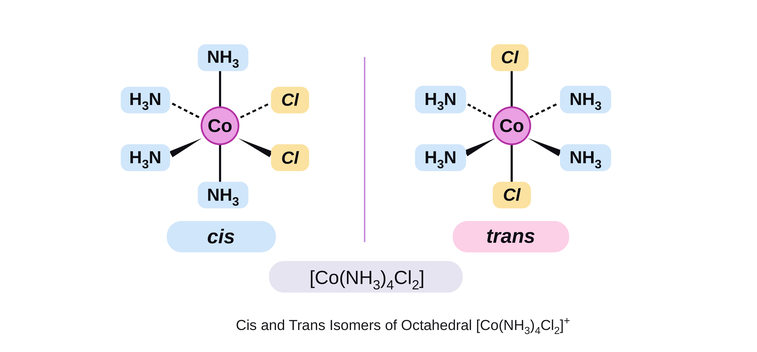
Example: [Co(NH₃)₄Cl₂]⁺
This complex exists in two geometrical forms:
- Cis-isomer: The two chloride ligands are adjacent to each other.
- Trans-isomer: The two chloride ligands are opposite to each other.
Fac-Mer Isomerism
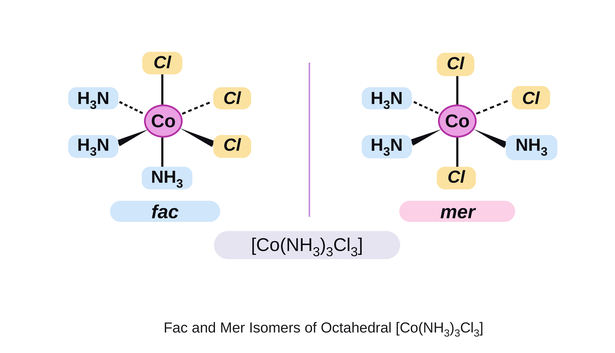
Another type of geometrical isomerism is observed in octahedral complexes of the type [Ma₃b₃], where three ligands of one type and three ligands of another type are attached to the central metal ion. This is known as facial (fac) and meridional (mer) isomerism.
Example: [Co(NH₃)₃(NO₂)₃]
- Facial (fac) Isomer
When three identical ligands occupy the corners of one triangular face of an octahedron, the arrangement is called the facial isomer. In this arrangement, all three identical ligands are mutually cis.
- Meridional (mer) Isomer
When three identical ligands occupy positions around a meridian of the octahedron, the arrangement is called the meridional isomer. In this arrangement, two of the three identical ligands are trans to each other.
Remember:
- Cis = Adjacent positions
- Trans = Opposite positions
- Fac = Three identical ligands on one triangular face
- Mer = Three identical ligands arranged around a meridian
Ready to Score Better in Your Class 12 Exams?
Join Xylem Online Tuition and learn your subjects step by step, with simple explanations and regular practice.
Register NowWhy Do Tetrahedral Complexes Not Show Geometrical Isomerism?
Tetrahedral complexes do not show geometrical isomerism because all four positions around the central metal ion are equivalent. Therefore, different arrangements of two types of unidentate ligands do not produce distinct cis and trans forms.
Optical Isomerism
Optical isomerism occurs when two coordination compounds are non-superimposable mirror images of each other. These isomers are called enantiomers.
The compounds that show optical isomerism are called chiral compounds.
Optical isomers rotate the plane of plane-polarised light in opposite directions.
- Dextrorotatory (d): Rotates plane-polarised light to the right (clockwise).
- Laevorotatory (l): Rotates plane-polarised light to the left (anticlockwise).
Note: The symbols Δ (delta) and Λ (lambda) describe the spatial arrangement or configuration of ligands around the central metal ion. They do not indicate the direction of rotation of plane-polarised light. The direction of optical rotation is represented by d (+) or l (−) and is determined experimentally.
Example: [Co(en)₃]³⁺
The complex [Co(en)₃]³⁺ shows optical isomerism because it exists in two forms that are mirror images of each other and cannot be superimposed.
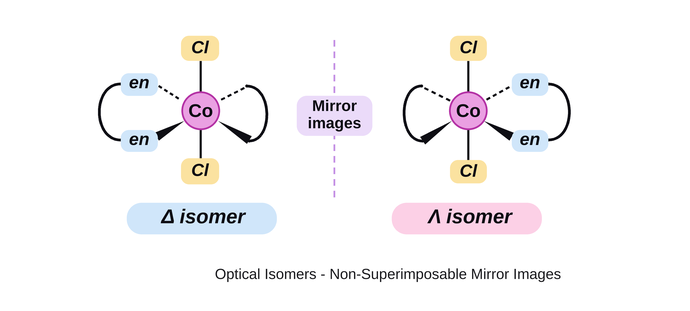
Here, en represents ethane-1,2-diamine, a bidentate ligand.
Another important NCERT example is [PtCl₂(en)₂]²⁺, in which only the cis-isomer shows optical activity.
Important example:
In the following two complexes:
- cis-[CrCl₂(ox)₂]³⁻
- trans-[CrCl₂(ox)₂]³⁻
Only the cis-isomer is optically active, while the trans-isomer is optically inactive.
Here, ox represents the oxalate ion (C₂O₄²⁻).
Remember: Optical isomers are non-superimposable mirror images of each other.
Difference Between Structural Isomerism and Stereoisomerism
| Structural Isomerism | Stereoisomerism |
|---|---|
| Isomers have different bonding arrangements. | Isomers have the same bonding arrangement. |
| The connectivity of atoms or ligands differs. | The spatial arrangement of ligands differs. |
| Includes linkage, coordination, ionisation and solvate isomerism. | Includes geometrical and optical isomerism. |
| Example: [Co(NH3)5SO4]Br and [Co(NH3)5Br]SO4 | Example: cis- and trans-[Pt(NH3)2Cl2] |
Quick Revision: Isomerism in Coordination Compounds
| Type of Isomerism | Main Feature | Example |
|---|---|---|
| Linkage | Different donor atoms of an ambidentate ligand | Nitro and nitrito forms |
| Coordination | Exchange of ligands between complex cation and anion | [Co(NH3)6][Cr(CN)6] |
| Ionisation | Exchange between a coordinated ligand and a counter ion | [Co(NH3)5SO4]Br |
| Solvate | Different positions of solvent molecules | Chromium(III) chloride hydrates |
| Geometrical | Different spatial arrangements of ligands | Cis-trans forms |
| Optical | Non-superimposable mirror images | [Co(en)3]3+ |
FAQs
Isomerism is the phenomenon in which two or more coordination compounds have the same chemical formula but different structural or spatial arrangements.
The two main types are structural isomerism and stereoisomerism.
Linkage isomerism occurs when an ambidentate ligand coordinates through different donor atoms.
Coordination isomerism occurs due to the interchange of ligands between complex cations and complex anions.
Ionisation isomerism occurs when a coordinated ligand and a counter ion exchange positions, producing different ions in solution.
Hydrate isomerism occurs when water molecules are present in different positions, either inside or outside the coordination sphere.
In cis-isomers, identical ligands occupy adjacent positions. In trans-isomers, identical ligands occupy opposite positions.
Fac and mer are geometrical isomers of octahedral complexes of the type [Ma₃b₃]. In fac isomers, three identical ligands occupy one triangular face. In mer isomers, they are arranged around a meridian.
All four positions in a tetrahedral complex are equivalent, so different arrangements of two types of unidentate ligands do not produce distinct geometrical isomers.
Optical isomerism occurs when compounds exist as non-superimposable mirror images called enantiomers.
[Co(en)₃]³⁺ is an example of a coordination compound that shows optical isomerism.