

Valence Bond Theory (VBT) is used to explain the bonding, geometry, and magnetic properties of coordination compounds. It helps us understand how ligands form coordinate bonds with a central metal ion and how the metal ion’s orbitals participate in bond formation.
For Class 12 Chemistry, understanding VBT is important because questions often involve identifying the hybridisation, geometry, and magnetic nature of coordination complexes.
What Is Valence Bond Theory?
Valence Bond Theory explains the formation of coordination compounds through the overlap of vacant hybrid orbitals of the central metal atom or ion with the filled orbitals of ligands.
In simple terms, the central metal ion provides vacant orbitals, while the ligands donate lone pairs of electrons to these orbitals. This forms coordinate bonds between the metal ion and the ligands.
Main features of Valence Bond Theory
Lorem ipsum dolor sit amet, consectetur adipiscing elit. Ut elit tellus, luctus nec ullamcorper mattis, pulvinar dapibus leo.
The important Features of VBT are:
- The central metal atom or ion makes available a number of vacant orbitals equal to its coordination number.
- These orbitals undergo hybridisation to form equivalent hybrid orbitals.
- Each donor atom of a ligand donates a lone pair of electrons into a vacant hybrid orbital of the central metal atom or ion, forming a coordinate bond The type of hybridisation determines the geometry of the coordination compound.
- The pairing of electrons in the metal’s d-orbitals depends on the nature of the ligands.
- The number of unpaired electrons helps determine whether a coordination compound is paramagnetic or diamagnetic.
Hybridisation and Geometry in Coordination Compounds
Hybridisation is the mixing of atomic orbitals of similar energies to form new hybrid orbitals.
In coordination compounds, the hybridisation of the central metal ion helps determine the arrangement of ligands around it.
Some important hybridisation and geometry combinations are:
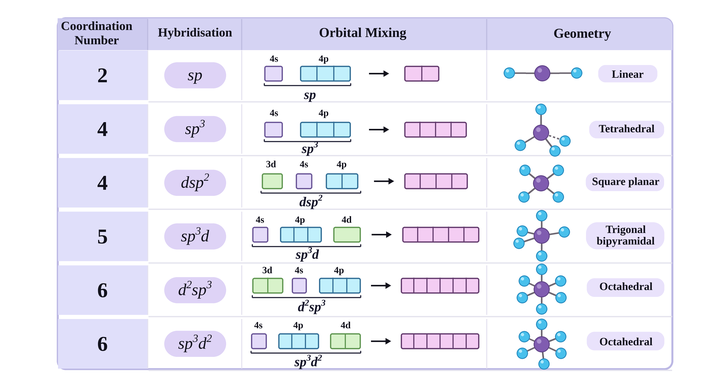
Important: Coordination number 4 can produce either tetrahedral or square-planar geometry. Similarly, coordination number 6 can produce two types of octahedral hybridisation.
Ready to Score Better in Your Class 12 Exams?
Join Xylem Online Tuition and learn your subjects step by step, with simple explanations and regular practice.
Register NowInner Orbital and Outer Orbital Complexes
Based on the orbitals involved in hybridisation, coordination compounds are classified into inner-orbital and outer-orbital complexes.
Inner Orbital Complexes
Inner-orbital complexes are formed when the central metal ion uses its inner (n−1)d orbitals along with s and p orbitals for hybridisation.
- Hybridisation: d²sp³ (octahedral) or dsp² (square planar).
- Electron pairing may occur in the inner d-orbitals when the ligand causes pairing.
- These complexes are often associated with strong-field ligands.
Example: [Co(CN)₆]³⁻
Here, CN⁻ is a strong-field ligand. It causes the electrons in the 3d orbitals of Co³⁺ to pair up, making two 3d orbitals available for hybridisation.
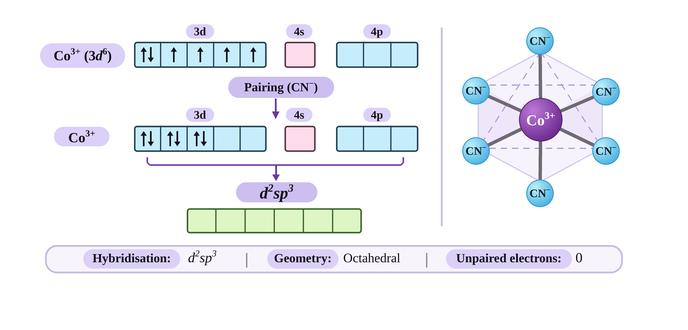
Therefore:
- Hybridisation = d²sp³
- Geometry = Octahedral
- Unpaired electrons = 0
- Magnetic nature = Diamagnetic
Outer Orbital Complexes
Outer-orbital complexes are formed when the central metal ion uses its outer (nd) orbitals along with s and p orbitals for hybridisation.
- Hybridisation: sp³d² (octahedral).
- Inner d-electrons do not pair up to create vacant inner d-orbitals.
- These complexes are often associated with weak-field ligands.
Example: [CoF₆]³⁻
Here, F⁻ is a weak-field ligand. It does not cause the electrons in the 3d orbitals of Co³⁺ to pair up.
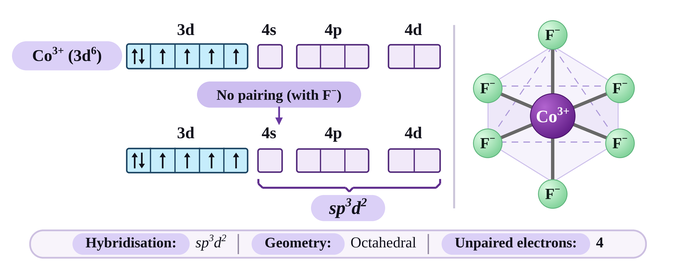
Therefore:
- Hybridisation = sp³d²
- Geometry = Octahedral
- Unpaired electrons = 4
- Magnetic nature = Paramagnetic
Strong-Field and Weak-Field Ligands
The nature of a ligand influences whether electrons in the d-orbitals of the central metal ion pair up or remain unpaired.
Strong-field ligands: These ligands can cause pairing of electrons in the metal’s d-orbitals.
Examples: CN⁻, CO, and nitro (N-bonded NO₂⁻).
Weak-field ligands: These ligands generally do not cause pairing of electrons in the metal’s d-orbitals.
Examples: F⁻, Cl⁻ and Br⁻.
This distinction is particularly useful when determining the hybridisation and magnetic properties of coordination compounds.
Worked Examples of VBT
Let’s understand how to determine the hybridisation, geometry and magnetic nature of coordination compounds using some important examples.
Example 1: [Ni(CN)₄]²⁻
Step 1: Find the oxidation state of Ni.
Let the oxidation state of Ni be x.
x + 4(−1) = −2
x = +2
Therefore, Ni²⁺ has the electronic configuration 3d⁸.
Step 2: Identify the ligand strength.
CN⁻ is a strong-field ligand. It causes the 3d electrons to pair up.
Step 3: Determine hybridisation.
One 3d orbital, one 4s orbital, and two 4p orbitals participate in hybridisation.
Hybridisation = dsp²
Step 4: Determine geometry and magnetic nature.
- Geometry: Square planar
- Unpaired electrons: 0
- Magnetic nature: Diamagnetic
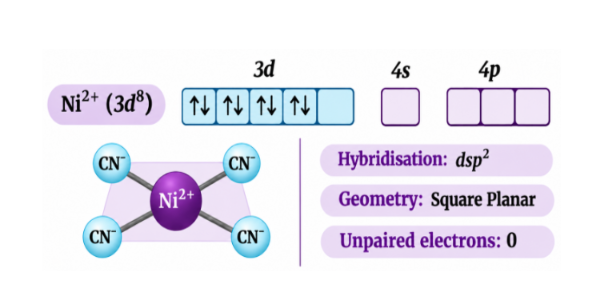
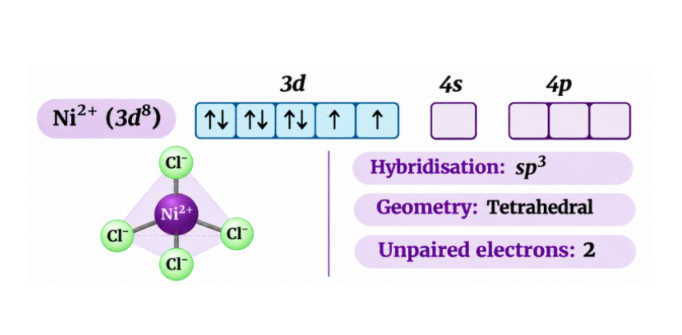
Example 2: [NiCl₄]²⁻
Step 1: Find the oxidation state of Ni.
Let the oxidation state of Ni be x.
x + 4(−1) = −2
x = +2
Therefore, Ni²⁺ has the electronic configuration 3d⁸.
Step 2: Identify the ligand strength.
Cl⁻ is a weak-field ligand. It does not cause pairing of the 3d electrons.
Step 3: Determine hybridisation.
One 4s orbital and three 4p orbitals participate in hybridisation.
Hybridisation = sp³
Step 4: Determine geometry and magnetic nature.
- Geometry: Tetrahedral
- Unpaired electrons: 2
- Magnetic nature: Paramagnetic
Example 3: [Co(CN)₆]³⁻
Step 1: Find the oxidation state of Co.
Let the oxidation state of Co be x.
x + 6(−1) = −3
x = +3
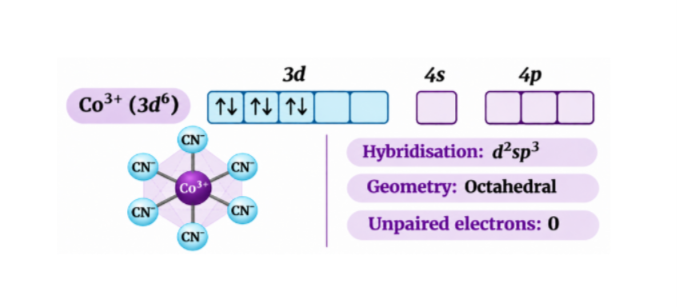
Therefore, Co³⁺ has the electronic configuration 3d⁶.
Step 2: Identify the ligand strength.
CN⁻ is a strong-field ligand. It causes pairing of electrons in the 3d orbitals.
Step 3: Determine hybridisation.
Two vacant 3d orbitals, one 4s orbital, and three 4p orbitals participate in hybridisation.
Hybridisation = d²sp³
Step 4: Determine geometry and magnetic nature.
- Geometry: Octahedral
- Unpaired electrons: 0
- Magnetic nature: Diamagnetic
Example 4: [CoF₆]³⁻
Step 1: Find the oxidation state of Co.
Let the oxidation state of Co be x.
x + 6(−1) = −3
x = +3
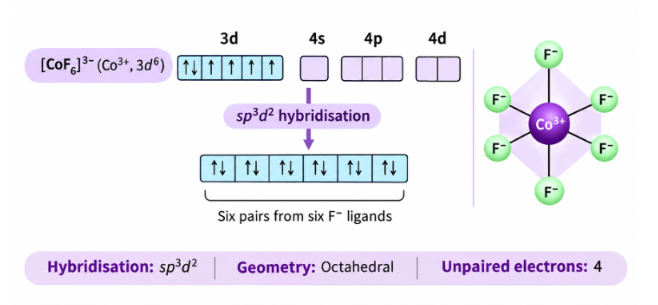
Therefore, Co³⁺ has the electronic configuration 3d⁶.
Step 2: Identify the ligand strength.
F⁻ is a weak-field ligand. It does not cause pairing of the 3d electrons.
Step 3: Determine hybridisation.
The complex uses two 4d orbitals, one 4s orbital and three 4p orbitals for hybridisation.
Hybridisation = sp³d²
Step 4: Determine geometry and magnetic nature.
- Geometry: Octahedral
- Unpaired electrons: 4
- Magnetic nature: Paramagnetic
Magnetic Properties of Coordination Compounds
The magnetic behaviour of a coordination compound depends on the number of unpaired electrons present in its central metal ion.
There are two main types:
- Paramagnetic compounds
Compounds containing one or more unpaired electrons are called paramagnetic compounds. They are attracted towards an external magnetic field.
Examples:
- [NiCl₄]²⁻
- [CoF₆]³⁻
- Diamagnetic compounds
Compounds in which all electrons are paired are called diamagnetic compounds. They are weakly repelled by an external magnetic field.
Examples:
- [Ni(CN)₄]²⁻
- [Co(CN)₆]³⁻
Magnetic Moment Formula
The spin-only magnetic moment of a coordination compound can be calculated using:
μ = √[n(n + 2)] BM
Where:
- μ = Magnetic moment
- n = Number of unpaired electrons
- BM = Bohr Magneton
Example:
If a coordination compound has 2 unpaired electrons:
μ = √[2(2 + 2)]
μ = √8
μ ≈ 2.83 BM
Therefore, the spin-only magnetic moment is approximately 2.83 BM.
Limitations of Valence Bond Theory
Although VBT helps explain the bonding, geometry and magnetic properties of coordination compounds, it has some limitations.
- It does not explain the colour of coordination compounds.
- It does not explain the splitting of d-orbitals in the presence of ligands.
- It does not provide a quantitative explanation for the stability of coordination compounds.
- VBT does not independently explain or predict the distinction between weak-field and strong-field ligands.
- It does not provide a quantitative explanation of the magnetic behaviour of coordination compounds.
- VBT cannot accurately predict whether a four-coordinate complex will adopt tetrahedral or square-planar geometry.
These limitations led to the development of Crystal Field Theory, which explains d-orbital splitting and helps account for the colour and magnetic behaviour of coordination compounds.
Quick Revision Table
| Complex | Ligand Field Strength | Hybridisation | Geometry | Magnetic Nature |
|---|---|---|---|---|
| [Ni(CN)₄]²⁻ | Strong Field | dsp² | Square Planar | Diamagnetic |
| [NiCl₄]²⁻ | Weak Field | sp³ | Tetrahedral | Paramagnetic |
| [Co(CN)₆]³⁻ | Strong Field | d²sp³ | Octahedral | Diamagnetic |
| [CoF₆]³⁻ | Weak Field | sp³d² | Octahedral | Paramagnetic |
FAQ's
Valence Bond Theory explains the bonding in coordination compounds through the overlap of vacant hybrid orbitals of the central metal ion with the filled orbitals of ligands.
Inner-orbital complexes use inner (n−1)d orbitals for hybridisation, whereas outer-orbital complexes use outer and orbitals.
The hybridisation of [Ni(CN)₄]²⁻ is dsp², and its geometry is square planar.
CN⁻ is a strong-field ligand that causes pairing of the 3d electrons of Ni²⁺. As a result, the complex has no unpaired electrons and is diamagnetic.
Cl⁻ is a weak-field ligand. The complex has two unpaired electrons and is therefore paramagnetic.
Both produce octahedral geometry. However, d²sp³ uses two inner (n−1)d orbitals, while sp³d² uses two outer and orbitals.
The spin-only magnetic moment is calculated using:
μ = √[n(n + 2)] BM
where n is the number of unpaired electrons.