

Crystal Field Theory (CFT) explains the bonding and properties of coordination compounds by considering the interaction between the central metal ion and the surrounding ligands.
It helps explain the splitting of d-orbitals, the colour of coordination compounds and their magnetic properties.
For Class 12 Chemistry, Crystal Field Theory is important because questions often involve orbital splitting diagrams, electron configurations, high-spin and low-spin complexes, and magnetic behaviour.
What Is Crystal Field Theory?
Crystal Field Theory is based on the electrostatic interaction between the central metal ion and the ligands surrounding it. According to CFT, when ligands approach a central metal ion, their electron pairs repel the electrons present in the metal’s d-orbitals.
In an isolated metal ion, all five d-orbitals have the same energy. They are called degenerate orbitals.
When ligands approach the metal ion, the d-orbitals experience different amounts of repulsion depending on their orientation. As a result, they split into groups with different energy levels. This phenomenon is called crystal field splitting.
Degenerate d-Orbitals
In a free metal ion, the five d-orbitals have the same energy.
The five d-orbitals are:
- dₓᵧ
- dᵧz
- dₓ𝓏
- dₓ²₋ᵧ²
- d𝓏²
When ligands approach the metal ion, the energy of these orbitals changes depending on their orientation relative to the ligands. The pattern of splitting depends on the geometry of the coordination complex.
Crystal Field Splitting in Octahedral Complexes
In an octahedral complex, six ligands approach the central metal ion along the positive and negative x, y, and z axes.
The five d-orbitals split into two groups:
- Lower-energy orbitals (t₂g)
The dₓᵧ, dᵧ𝓏 and dₓ𝓏 orbitals form the lower-energy group.
These orbitals lie between the axes, so they experience less repulsion from the approaching ligands.
- Higher-energy orbitals (eg)
The dₓ²₋ᵧ² and d𝓏² orbitals form the higher-energy group. These orbitals point directly towards the ligands along the axes, so they experience greater repulsion.
The energy difference between these two groups is called the octahedral crystal field splitting energy, represented by Δ₀.
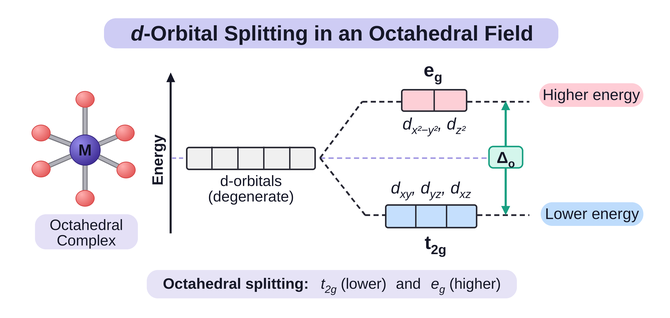
- t₂g orbitals: Lower energy
- eg orbitals: Higher energy
The average energy of the five d-orbitals remains unchanged upon crystal field splitting relative to the unsplit set.
Ready to Score Better in Your Class 12 Exams?
Join Xylem Online Tuition and learn your subjects step by step, with simple explanations and regular practice.
Register NowEnergy of Octahedral d-Orbitals
Relative to the average energy (barycentre):
- Each t₂g orbital is lowered by 0.4 Δ₀.
- Each eg orbital is raised by 0.6 Δ₀.
These energy values are useful for understanding crystal field stabilisation energy.
Crystal Field Splitting in Tetrahedral Complexes
In a tetrahedral complex, four ligands approach the central metal ion from the corners of a tetrahedron. Unlike octahedral complexes, the d-orbitals split in the opposite order.
The five d-orbitals form two groups:
- Lower-energy orbitals (e)
The dₓ²₋ᵧ² and d𝓏² orbitals form the lower-energy group.
- Higher-energy orbitals (t₂)
The dₓᵧ, dᵧ𝓏 and dₓ𝓏 orbitals form the higher-energy group.
The energy difference between these groups is called tetrahedral crystal field splitting energy, represented by Δₜ.
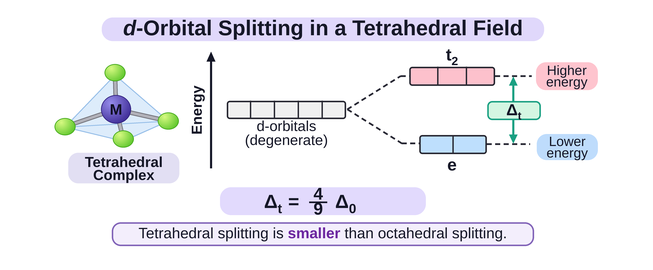
- e orbitals: Lower energy
- t₂ orbitals: Higher energy
The tetrahedral splitting energy is smaller than the octahedral splitting energy.
The approximate relationship is:
Δₜ = 4/9 Δ₀
Because tetrahedral splitting is relatively small, tetrahedral complexes are generally high-spin complexes.
Octahedral vs Tetrahedral Splitting
| Feature | Octahedral | Tetrahedral |
|---|---|---|
| Coordination number | 6 | 4 |
| Lower-energy orbitals | t2g | e |
| Higher-energy orbitals | eg | t2 |
| Splitting energy | Δo | Δt |
| Relative splitting | Larger | Smaller |
| Spin behaviour | High-spin or low-spin possible | Generally high-spin |
Strong-Field and Weak-Field Ligands
Different ligands produce different amounts of crystal field splitting. Based on their ability to split the d-orbitals, ligands are classified as strong-field and weak-field ligands.
Strong-field ligands
These ligands produce a relatively large crystal field splitting energy.
Examples:
- CN⁻
- CO
- NO₂⁻
Weak-field ligands
These ligands produce a relatively small crystal field splitting energy.
Examples:
- I⁻
- Br⁻
- Cl⁻
- F⁻
The order of ligands based on their increasing field strength is called the spectrochemical series.
A commonly used simplified spectrochemical series is:
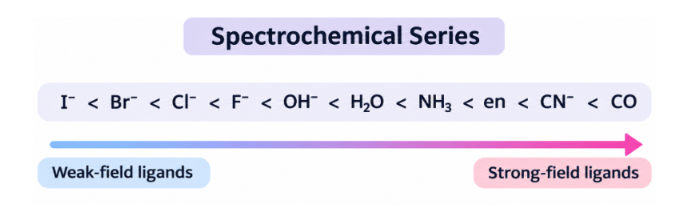
Ligands on the left generally produce smaller splitting, while ligands on the right produce larger splitting.
High-Spin and Low-Spin Complexes
In octahedral complexes, the arrangement of d-electrons depends on the relative magnitudes of crystal field splitting energy (Δ₀) and pairing energy (P).
Pairing energy (P) is the energy required to pair two electrons in the same orbital.
High-Spin Complexes
When the crystal field splitting energy is smaller than the pairing energy, electrons prefer to occupy the higher-energy orbitals rather than pair up in the lower-energy orbitals. This produces a greater number of unpaired electrons. Such complexes are called high-spin complexes.
They are generally formed with weak-field ligands.
Low-Spin Complexes
When the crystal field splitting energy is greater than the pairing energy, electrons prefer to pair up in the lower-energy orbitals instead of occupying the higher-energy orbitals. This produces fewer unpaired electrons. Such complexes are called low-spin complexes.
They are generally formed with strong-field ligands.
Important: High-spin and low-spin arrangements are particularly relevant to octahedral complexes with d⁴ to d⁷ configurations. Not every metal ion or coordination complex can form both arrangements.
Electron Distribution in Octahedral Complexes
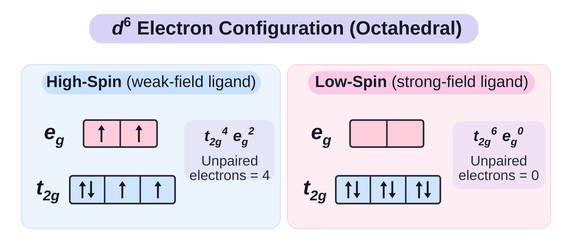
Let’s understand high-spin and low-spin arrangements using d⁶ complexes.
High-Spin d⁶ Configuration
When a weak-field ligand is present, electrons occupy the orbitals to maximise the number of unpaired electrons before pairing.
The configuration is:
t₂g⁴ eᵍ²
Number of unpaired electrons = 4
Example: [FeF₆]⁴⁻
Low-Spin d⁶ Configuration
When a strong-field ligand is present, electrons pair up in the lower-energy t₂g orbitals before entering the higher-energy eᵍ orbitals.
The configuration is:
t₂g⁶ eᵍ⁰
Number of unpaired electrons = 0
Example: [Fe(CN)₆]⁴⁻
Both complexes contain Fe²⁺, which has a d⁶ configuration. However, their electron arrangements and magnetic properties differ because of the different ligand strengths.
Crystal Field Stabilisation Energy (CFSE)
When d-orbitals split into different energy levels, electrons occupy the lower-energy orbitals first. The energy gained by the metal ion due to this splitting is called crystal field stabilisation energy (CFSE).
For an octahedral complex:
- Each electron in a t₂g orbital contributes −0.4 Δ₀.
- Each electron in an eᵍ orbital contributes +0.6 Δ₀.
Therefore:
CFSE = (−0.4 × number of t₂g electrons + 0.6 × number of eᵍ electrons) Δ₀
Example:
For a low-spin d⁶ octahedral complex:
Configuration = t₂g⁶ eᵍ⁰
CFSE = (6 × −0.4 + 0 × 0.6) Δ₀
CFSE = −2.4 Δ₀
The negative value indicates stabilisation relative to the unsplit d-orbital arrangement.
Colour of Coordination Compounds
Many coordination compounds are coloured because they absorb particular wavelengths of visible light. In an octahedral complex, the energy difference between the t₂g and eᵍ orbitals may correspond to the energy of visible light.
When light is absorbed, an electron can move from a lower-energy d-orbital to a higher-energy d-orbital.
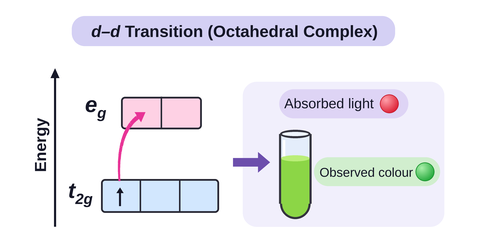
This is called a d-d transition. The colour observed is generally complementary to the colour of light absorbed.
For example, if a complex absorbs light mainly in the red region, it may appear green.
Important points:
- The colour depends on the energy difference between the d-orbital groups.
- Different ligands can produce different splitting energies.
- Complexes with d⁰ or d¹⁰ configurations generally do not show d-d transitions.
- Some d⁰ and d¹⁰ complexes can still be coloured due to charge-transfer transitions.
Magnetic Properties of Coordination Compounds
The magnetic behaviour of a coordination compound depends on the number of unpaired electrons.
Paramagnetic complexes
Complexes containing one or more unpaired electrons are paramagnetic. They are attracted towards an external magnetic field.
Example: [FeF₆]⁴⁻ has four unpaired electrons.
Diamagnetic complexes
Complexes in which all electrons are paired are diamagnetic. They are weakly repelled by an external magnetic field.
Example: [Fe(CN)₆]⁴⁻ has no unpaired electrons.
The spin-only magnetic moment can be calculated using:
μ = √[n(n + 2)] BM
Where:
- μ = Magnetic moment
- n = Number of unpaired electrons
- BM = Bohr magneton
For [FeF₆]⁴⁻, n = 4.
μ = √[4(4 + 2)]
μ = √24 ≈ 4.90 BM
Therefore, its spin-only magnetic moment is approximately 4.90 BM.
Limitations of Crystal Field Theory
Although CFT explains several properties of coordination compounds, it has some limitations.
- It considers the interaction between metal ions and ligands mainly as electrostatic.
- It does not fully explain the covalent character of metal–ligand bonding.
- It cannot completely explain the relative strengths of all ligands from first principles.
- It does not provide a complete explanation of all bonding and stability properties of coordination compounds.
Quick Revision Table
| Concept | Key Point |
|---|---|
| Crystal field splitting | Splitting of d-orbitals into different energy levels |
| Octahedral splitting | t2g lower, eg higher |
| Tetrahedral splitting | e lower, t2 higher |
| Octahedral splitting energy | Δo |
| Tetrahedral splitting energy | Δt |
| Relationship | Δt = 4⁄9 Δo |
| Strong-field ligands | Produce larger splitting |
| Weak-field ligands | Produce smaller splitting |
| High-spin complex | More unpaired electrons |
| Low-spin complex | Fewer unpaired electrons |
| CFSE | Stabilisation due to d-orbital splitting |
| d–d transition | Electron transition between split d-orbitals |
FAQ's
Crystal Field Theory explains the interaction between a central metal ion and surrounding ligands through electrostatic interactions. It explains the splitting of d-orbitals in coordination compounds.
It is the energy difference between the groups of d-orbitals formed when ligands approach the central metal ion.
In octahedral complexes, t₂g orbitals are lower in energy and eᵍ orbitals are higher. In tetrahedral complexes, e orbitals are lower and t₂ orbitals are higher.
It is the arrangement of ligands in increasing order of their ability to produce crystal field splitting.
High-spin complexes have more unpaired electrons, while low-spin complexes have fewer unpaired electrons due to electron pairing in lower-energy orbitals.
Tetrahedral splitting energy is relatively small compared with pairing energy. Therefore, electrons generally occupy higher-energy orbitals before pairing up.
Many coordination compounds absorb visible light due to d–d transitions between split d-orbitals. The colour observed depends on the wavelengths absorbed.
Crystal Field Stabilisation Energy is the stabilisation gained by electrons occupying the lower-energy d-orbitals after crystal field splitting.