

Coordination compounds are an important part of Class 12 Chemistry. They help explain how metal ions interact with molecules or ions called ligands and how these interactions determine the structure, colour, magnetic behaviour, and stability of the resulting compounds.
This chapter covers the basic terms of coordination chemistry, nomenclature, isomerism, bonding theories, crystal field splitting, magnetic properties, stability and applications.
What Are Coordination Compounds?
A coordination compound is a compound that contains a coordination entity in which a central metal atom or ion is surrounded by a definite number of ligands.
For example:
[Co(NH₃)₆]Cl₃
Here, Co³⁺ is the central metal ion, and six NH₃ molecules are directly attached to it. The three Cl⁻ ions are outside the coordination sphere.
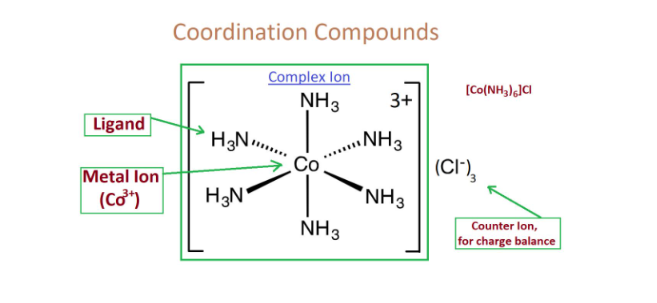
In [Co(NH₃)₆]Cl₃:
- Co³⁺ is the central metal ion.
- NH₃ is the ligand.
- [Co(NH₃)₆]³⁺ is the coordination entity.
- Cl⁻ ions are counter ions.
- The coordination number of Co³⁺ is 6.
A coordination entity can be positively charged, negatively charged, or neutral. A charged coordination entity is called a complex ion.
Important Terms in Coordination Compounds
Coordination Entity
A coordination entity is a species in which a central metal atom or ion is surrounded by a definite number of ligands.
Examples:
- [Co(NH₃)₆]³⁺
- [Fe(CN)₆]⁴⁻
- [Cu(NH₃)₄]²⁺
A coordination entity can have a positive, negative, or zero charge. A charged coordination entity is also called a complex ion.
Central Metal Atom or Ion
The central metal atom or ion is the metal atom or ion to which the ligands are directly bonded.
For example, in:
[Fe(CN)₆]⁴⁻
Fe is the central metal ion and CN⁻ ions are the ligands.
Ligand
A ligand is an ion or molecule that donates one or more electron pairs to the central metal atom or ion to form coordinate bonds.
Examples:
NH₃, H₂O, Cl⁻, CN⁻, OH⁻ , and en. These include different types of ligands based on how they coordinate with the central metal ion.
The atom of the ligand that directly donates the electron pair to the metal is called the donor atom.
For example:
- NH₃ → N is the donor atom
- H₂O → O is the donor atom
- CN⁻ → C is the donor atom when coordinated through carbon
Coordination Number
The coordination number of a central metal atom or ion is the number of donor atoms directly bonded to it.
For example: [Co(NH₃)₆]³⁺
Each NH₃ ligand has one donor atom.
Therefore:
Coordination number = 6
But don’t simply count the number of ligands in every complex.
Consider:
[Co(en)₃]³⁺
Here, three en molecules are present. Each en ligand has two donor atoms.
Therefore:
Coordination number = 3 × 2 = 6
So:
Number of ligands = 3 , But Coordination number = 6
This difference is very important in entrance-exam questions.
Coordination Sphere
The central metal atom or ion and the ligands directly attached to it are collectively called the coordination sphere.
The coordination sphere is written inside square brackets.
Example : [Co(NH₃)₆]Cl₃
Here:
[Co(NH₃)₆]³⁺ is the coordination sphere. The Cl⁻ ions are outside the coordination sphere.
Counter Ions
The ions present outside the coordination sphere and responsible for balancing its charge are called counter ions.
In [Co(NH₃)₆]Cl₃, the three Cl⁻ ions are counter ions.
Oxidation State of the Central Metal
The oxidation state of the central metal can be found by considering the charges of the ligands and the overall charge of the coordination entity.
For: [Co(NH₃)₆]³⁺
NH₃ is neutral. Therefore, the oxidation state of Co = +3
For: [Fe(CN)₆]⁴⁻
Let the oxidation state of Fe be x.
x + 6(−1) = −4
x = +2
Therefore, Fe is in the +2 oxidation state.
Coordination Number and Geometry
The arrangement of ligands around the central metal ion depends on factors such as coordination number and the nature of the complex.
| Coordination Number | Common Geometry | Example |
|---|---|---|
| 2 | Linear | [Ag(NH3)2]+ |
| 4 | Tetrahedral | [NiCl4]2− |
| 4 | Square planar | [Ni(CN)4]2− |
| 6 | Octahedral | [Co(NH3)6]3+ |
Coordination number 4 can therefore have either tetrahedral or square-planar geometry.
IUPAC Nomenclature of Coordination Compounds
Coordination compounds are named according to specific IUPAC rules. The IUPAC Nomenclature of Coordination Compounds follows a systematic order in which the names of ligands are generally written before the central metal, followed by the oxidation state of the metal in Roman numerals.
For example: [Co(NH₃)₆]Cl₃ , is named hexaamminecobalt(III) chloride.
For an anionic coordination entity, the name of the metal generally ends in -ate.
For example: K₄[Fe(CN)₆], is named potassium hexacyanidoferrate(II).
Isomerism in Coordination Compounds
Coordination compounds with the same molecular formula can have different arrangements or connectivity of their constituent groups. This phenomenon is called isomerism in coordination compounds.
It is broadly classified into:
Structural Isomerism
Structural isomerism results from differences in the arrangement or connectivity of the components.
The main types are:
- Ionisation isomerism
- Solvate or hydrate isomerism
- Linkage isomerism
- Coordination isomerism
Stereoisomerism
Stereoisomers have the same connectivity but differ in the spatial arrangement of their ligands.
The main types are:
- Geometrical isomerism
- Optical isomerism
Geometrical isomerism includes cis-trans forms and, in suitable octahedral complexes, fac-mer forms.
Werner's Theory
Werner’s theory explains coordination compounds using two types of valence. Primary valence corresponds to the oxidation state of the metal and is ionisable. Secondary valence corresponds to the coordination number and is satisfied by groups directly attached to the metal.
For [Co(NH₃)₆]Cl₃:
- Primary valence of Co = 3
- Secondary valence of Co = 6
Werner’s theory helped explain the difference between ions directly attached to the metal and ions present outside the coordination sphere.
Valence Bond Theory
Valence Bond Theory (VBT) explains the bonding in coordination compounds using the hybridisation of metal orbitals. According to VBT, the central metal atom or ion provides suitable vacant orbitals to accept electron pairs donated by the ligands.
Some important hybridisation and geometry combinations are:
| Hybridisation | Geometry |
|---|---|
| sp | Linear |
| sp3 | Tetrahedral |
| dsp2 | Square planar |
| d2sp3 | Octahedral |
| sp3d2 | Octahedral |
VBT also helps explain the presence of paired and unpaired electrons in coordination compounds.
Crystal Field Theory
The interaction between the central metal ion and surrounding ligands causes the d-orbitals to split into groups of different energies. This is explained by Crystal Field Theory (CFT).
In an octahedral complex, the five d-orbitals split into:
- t2g → lower energy
- eᵍ → higher energy
The energy difference between these two sets is called the octahedral crystal field splitting energy, Δ₀.
In a tetrahedral complex:
- e → lower energy
- t₂ → higher energy
The tetrahedral splitting energy is represented by Δₜ, where:
Δₜ ≈ 4/9 Δ₀
The magnitude of splitting depends on the ligand. This helps explain strong-field and weak-field ligands and the formation of high-spin and low-spin complexes.
Magnetic Properties
The magnetic behaviour of a coordination compound depends on the number of unpaired electrons. A compound with one or more unpaired electrons is paramagnetic, while a compound in which all electrons are paired is diamagnetic.
The spin-only magnetic moment is calculated using:
μ = √[n(n + 2)] BM
where n is the number of unpaired electrons.
For three unpaired electrons:
μ = √[3(3 + 2)]
μ = √15 ≈ 3.87 BM
Colour of Coordination Compounds
Many coordination compounds are coloured because they absorb particular wavelengths of visible light. In many transition-metal complexes, electrons absorb energy and move between the split d-orbitals. This is called a d-d transition. The colour observed depends on the wavelength of light absorbed.
Complexes with d⁰ or d¹⁰ configurations generally do not show d-d transitions. However, some coordination compounds can still be coloured because of charge-transfer transitions.
Stability of Coordination Compounds
The stability of a coordination compound can be expressed using formation or stability constants. Complex formation can occur through a series of steps:
M + L ⇌ ML
ML + L ⇌ ML₂
Each step has a stepwise formation constant such as K₁, K₂, K₃, and so on.
For the overall reaction:
M + nL ⇌ MLₙ
the overall formation constant is:
βₙ = K₁ × K₂ × K₃ × … × Kₙ
A larger formation constant generally indicates greater stability of the complex under the conditions considered.
Chelate Effect
Some ligands can coordinate with the same metal ion through two or more donor atoms and form ring structures. Such ligands are called chelating ligands. The increased stability of complexes formed with chelating ligands is known as the chelate effect.
Examples include en, oxalate and EDTA.
Applications of Coordination Compounds
Coordination compounds have applications in biological systems, medicine, qualitative analysis and metallurgy.
Biological Systems
Several important biological molecules contain metal ions as part of their coordination structures.
- Haemoglobin contains Fe.
- Chlorophyll contains Mg.
- Vitamin B₁₂ contains Co.
Medicine
Cisplatin is a platinum coordination compound used in the treatment of certain cancers.
Qualitative Analysis
The formation of coordination complexes is used to identify certain metal ions in qualitative analysis.
Extraction of Metals
The formation of suitable complexes is used in some methods for the extraction and purification of metals.
Coordination Compounds: Quick Revision
| Topic | Key Point |
|---|---|
| Coordination compound | Contains a coordination entity with a central metal and ligands |
| Ligand | Donates one or more electron pairs to the central metal |
| Coordination number | Number of donor atoms directly bonded to the metal |
| Primary valence | Corresponds to oxidation state |
| Secondary valence | Corresponds to coordination number |
| Coordination sphere | Central metal and directly attached ligands within brackets |
| Counter ion | Ion outside the coordination sphere |
| Octahedral splitting | t2g lower and eg higher |
| Tetrahedral splitting | e lower and t2 higher |
| Δt | Approximately 4/9 Δo |
| Paramagnetic | Has one or more unpaired electrons |
| Diamagnetic | All electrons are paired |
| Magnetic moment | μ = √[n(n + 2)] BM |
| d-d transition | Transition between split d-orbitals |
| Stability constant | Indicates the formation/stability of a complex |
| Chelate effect | Increased stability due to chelating ligands |