

IUPAC nomenclature provides a systematic method for naming coordination compounds. The name identifies the ligands attached to the central metal atom or ion, the number of each ligand, and the oxidation state of the central metal.
For Class 12 Chemistry, understanding a few basic rules makes the nomenclature of coordination compounds much easier. These rules are useful for board examinations as well as NEET and JEE preparation.
What Are the Basic Rules of IUPAC Nomenclature?
The name of a coordination compound is constructed by following a specific order:
Name of the cation → Name of the anion
Within a coordination entity, the order is:
Ligand names (alphabetical order) → Central metal name → Oxidation state in Roman numerals
For example:
[Co(NH₃)₆]Cl₃ is named hexaamminecobalt(III) chloride.
The following rules are used when naming coordination compounds:
| Rule | Key Point |
|---|---|
| 1 | Name the cation before the anion in ionic coordination compounds. |
| 2 | Name the ligands before the central metal atom or ion. |
| 3 | Arrange ligand names alphabetically, regardless of their electrical charge. |
| 4 | Use prefixes such as di-, tri-, tetra-, penta- and hexa- to indicate the number of identical simple ligands. |
| 5 | Use bis-, tris-, tetrakis-, etc., when ligand names are complex or already contain numerical prefixes. |
| 6 | Write the oxidation state of the central metal in Roman numerals inside parentheses, immediately after the metal name. |
| 7 | For anionic coordination entities, modify the metal name to end in -ate. |
What Are the Numerical Prefixes Used in Coordination Compounds?
Numerical prefixes indicate the number of identical simple ligands attached to the central metal atom or ion.
| Number | Prefix |
|---|---|
| 2 | di- |
| 3 | tri- |
| 4 | tetra- |
| 5 | penta- |
| 6 | hexa- |
Examples:
- 2 NH₃ ligands → diammine
- 3 Cl⁻ ligands → trichlorido
- 4 CO ligands → tetracarbonyl
These prefixes are used with simple ligand names; for complex ligand names or names that already contain numerical prefixes, bis-, tris-, and tetrakis- are used instead.
Ready to Score Better in Your Class 12 Exams?
Join Xylem Online Tuition and learn your subjects step by step, with simple explanations and regular practice.
Register NowHow Are Common Ligands Named?
Ligands are neutral molecules, anions, or cations that bond directly to the central metal atom or ion through coordinate bonds.
Anionic ligand names are modified according to the ending of the parent anion:
- -ide becomes -ido
- -ite becomes -ito
- -ate becomes -ato
| Ligand | IUPAC Ligand Name |
|---|---|
| NH3 | ammine |
| H2O | aqua |
| CO | carbonyl |
| NO | nitrosyl |
| F− | fluorido |
| Cl− | chlorido |
| Br− | bromido |
| I− | iodido |
| OH− | hydroxido |
| CN− | cyanido |
| NO2− (N-bound) | nitrito-κN |
| NO2− (O-bound) | nitrito-κO |
| SCN− (S-bound) | thiocyanato-κS |
| NCS− (N-bound) | thiocyanato-κN |
| C2O42− | oxalato |
Important Note: NH₃ is named ammine (with two ‘m’s) when it acts as a ligand in coordination compounds. Do not confuse it with amines, which are organic compounds containing nitrogen.
How to Find the Oxidation State of the Central Metal?
The oxidation state of the central metal is represented by Roman numerals in parentheses immediately after the metal name. To calculate it, make the algebraic sum of the oxidation state of the metal and the charges of all coordinated ligands equal to the overall charge of the coordination entity.
Example 1: [Co(NH₃)₆]³⁺
NH₃ is a neutral molecule (charge = 0).
Let the oxidation state of Co be x.
x + 6(0) = +3
x = +3
Therefore, cobalt is in the +3 oxidation state: cobalt(III).
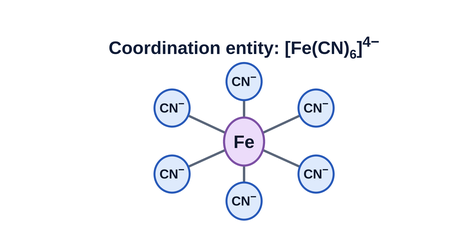
Example 2: [Fe(CN)₆]⁴⁻
CN⁻ carries a charge of -1.
Let the oxidation state of Fe be x.
x + 6(-1) = -4
x = +2
Therefore, iron is in the +2 oxidation state. Since the coordination entity is anionic, the metal is named ferrate(II).
Example 3: [CoCl₂(NH₃)₄]⁺
Cl⁻ carries a charge of -1, while NH₃ is neutral.
Let the oxidation state of Co be x.
x + 2(-1) + 4(0) = +1
x = +3
Therefore, cobalt is in the +3 oxidation state: cobalt(III).
How Are Ligands Arranged in the Name?
Ligand names are written in strict alphabetical order before the central metal name. Multiplicative prefixes such as di-, tri-, tetra-, bis- and tris- are ignored when determining alphabetical order.
Consider the coordination entity [CoCl₂(NH₃)₄]⁺.
Ligands present:
- NH₃ = ammine
- Cl⁻ = chlorido
Comparing the ligand names, ammine comes before chlorido alphabetically. The prefix tetra- does not affect the alphabetical order. Therefore, the name of the complex cation is:
tetraamminedichloridocobalt(III)
Ready to Score Better in Your Class 12 Exams?
Join Xylem Online Tuition and learn your subjects step by step, with simple explanations and regular practice.
Register NowHow Are Metals Named in Anionic Coordination Compounds?
When a coordination entity carries a negative charge, the name of the central metal is modified by adding the suffix -ate. For some metals, the Latin-derived stem is used instead of the regular element name.
| Metal | Name in Anionic Complex |
|---|---|
| Iron (Fe) | ferrate |
| Copper (Cu) | cuprate |
| Silver (Ag) | argentate |
| Gold (Au) | aurate |
| Lead (Pb) | plumbate |
| Tin (Sn) | stannate |
| Zinc (Zn) | zincate |
| Chromium (Cr) | chromate |
| Cobalt (Co) | cobaltate |
| Platinum (Pt) | platinate |
Examples:
- K₄[Fe(CN)₆]
The coordination entity is [Fe(CN)₆]⁴⁻.
Iron becomes ferrate because the coordination entity is negatively charged.
Name: potassium hexacyanidoferrate(II)
- K₂[Zn(OH)₄]
The coordination entity is [Zn(OH)₄]²⁻.
Zinc becomes zincate.
Name: potassium tetrahydroxidozincate(II)
How to Name Neutral Coordination Compounds?
A neutral coordination compound has no overall electrical charge. However, it may contain complex cations and complex anions whose charges balance each other.
A neutral coordination entity, on the other hand, has no overall electrical charge. In such complexes, the central metal retains its usual element name, followed by its oxidation state in Roman numerals inside parentheses.
Example: [Ni(CO)₄]
CO is a neutral ligand (charge = 0).
Let the oxidation state of Ni be x.
x + 4(0) = 0
x = 0
Therefore, the name is: tetracarbonylnickel(0)
How Are Anionic Ligands Named?
Anionic ligand names are modified according to the ending of the corresponding parent anion.
| Anion | Anion Formula | Ligand Name |
|---|---|---|
| Fluoride | F− | fluorido |
| Chloride | Cl− | chlorido |
| Bromide | Br− | bromido |
| Iodide | I− | iodido |
| Hydroxide | OH− | hydroxido |
| Cyanide | CN− | cyanido |
Example: [PtCl₂(NH₃)₂]
Ligands present:
- Two NH₃ ligands = diammine
- Two Cl⁻ ligands = dichlorido
The oxidation state of platinum is +2.
Let the oxidation state of Pt be x.
x + 2(-1) + 2(0) = 0
x = +2
Name: diamminedichloridoplatinum(II)
How Are Complex or Polydentate Ligands Named?
Some ligands have complicated names or already contain numerical prefixes. Using ordinary prefixes such as di-, tri-, and tetra- in these cases can make the name confusing.
Therefore, alternative multiplicative prefixes are used:
| Number of Ligands | Prefix |
|---|---|
| 2 | bis- |
| 3 | tris- |
| 4 | tetrakis- |
The complete ligand name is enclosed in parentheses following the multiplicative prefix. For example, ethane-1,2-diamine already contains the prefix di- in its name. Therefore, instead of using diethane-1,2-diamine, the prefix bis- is used: bis(ethane-1,2-diamine).
Examples:
- [Co(en)₃]³⁺
Name: tris(ethane-1,2-diamine)cobalt(III)
- [CoCl₂(en)₂]⁺
Name: dichloridobis(ethane-1,2-diamine)cobalt(III)
Here, en represents ethane-1,2-diamine, a neutral bidentate ligand.
How Are Ambidentate Ligands Named?
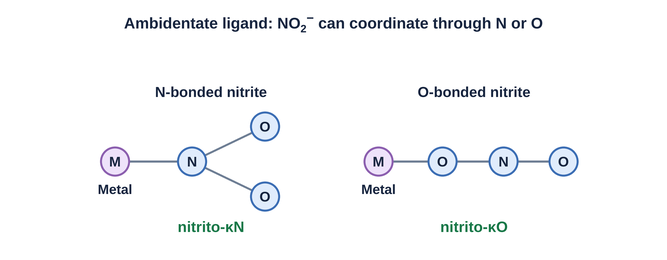
Ambidentate ligands have two or more possible donor atoms through which they can coordinate with a central metal atom. However, they coordinate through only one donor atom at a time.
The specific donor atom is identified using the Greek letter kappa (κ), followed by the symbol of the coordinating atom.
Easy way to remember:
κ = Which atom is connected to the metal?
| Ligand | Donor Atom | IUPAC Ligand Name |
|---|---|---|
| NO2− | Nitrogen | nitrito-κN |
| NO2− | Oxygen | nitrito-κO |
| SCN− | Sulfur | thiocyanato-κS |
| NCS− | Nitrogen | thiocyanato-κN |
Example: [PtCl(NH₃)₂(NO₂)]
Assuming the nitrite ligand is bonded through nitrogen:
Ligands in alphabetical order:
- NH₃ = ammine
- Cl⁻ = chlorido
- NO₂⁻ = nitrito-κN
Oxidation state of Pt:
x + (-1) + 2(0) + (-1) = 0
x = +2
Name: diamminechlorido(nitrito-κN)platinum(II)
Note: The formula alone does not identify whether NO₂⁻ is bonded through nitrogen or oxygen. The coordination structure must be known to specify the correct donor atom.
How Is the Formula of a Coordination Compound Written?
The formula and name of a coordination compound follow different ordering conventions.
When writing a coordination formula:
- Write the central metal symbol first inside square brackets.
- Write the ligand formulas or abbreviations after the central metal in alphabetical order according to their formula representations.
- Enclose the entire coordination entity in square brackets.
- Use parentheses to group polyatomic ligand formulas where necessary.
When naming a coordination compound:
- Name the ligands before the central metal.
- Arrange ligand names alphabetically.
- Ignore multiplicative prefixes while determining alphabetical order.
| Purpose | Ordering Convention |
|---|---|
| Naming the complex | Ligands are arranged alphabetically by their names. |
| Writing the formula | Central metal first, followed by ligand formulas or abbreviations in alphabetical order. |
For example:
[CoCl₂(NH₃)₄]⁺
The central metal comes first. The ligand formulas follow in alphabetical order: Cl comes before NH₃ because C comes before N.
Its name is tetraamminedichloridocobalt(III).
Similarly, [PtCl₂(NH₃)₂] follows formula ordering, while its name is diamminedichloridoplatinum(II).
Do not assume that the IUPAC name follows the left-to-right sequence of the chemical formula.
Naming Coordination Compounds: Step-by-Step
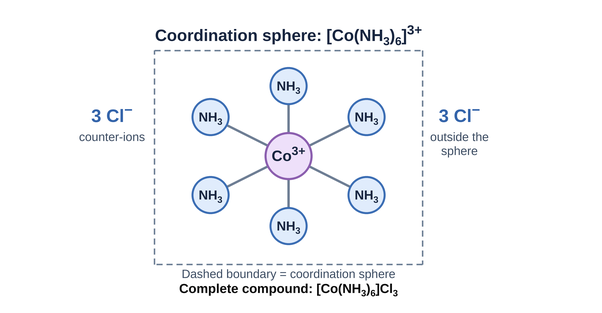
Consider [Co(NH₃)₆]Cl₃ as a standard example.
Step 1: Identify the coordination entity and counter-ion
Coordination entity: [Co(NH₃)₆]³⁺
Counter-ion: Cl⁻
Step 2: Identify and count the ligands
There are six neutral NH₃ molecules. Six ammine ligands are named hexaammine.
Step 3: Arrange the ligands alphabetically
Only one type of ligand is present: hexaammine.
Step 4: Determine the oxidation state of the metal
Let the oxidation state of Co be x.
x + 6(0) = +3
x = +3
Step 5: Name the central metal
Since the coordination entity is positively charged, use the regular metal name: cobalt(III). The name of the coordination entity is hexaamminecobalt(III).
Step 6: Name the counter-ion
Cl⁻ outside the coordination sphere is named chloride.Do not use prefixes such as tri- to indicate the number of counter-ions in the compound name.
Full IUPAC Name: hexaamminecobalt(III) chloride
What Are Some Important Examples of IUPAC Nomenclature?
The following examples cover different types of coordination compounds and are useful for board examinations and entrance tests.
Example 1: [Co(NH₃)₆]Cl₃
- Coordination entity: [Co(NH₃)₆]³⁺
- Co oxidation state: +3
- Ligand: ammine
Name: hexaamminecobalt(III) chloride
Example 2: K₄[Fe(CN)₆]
- Coordination entity: [Fe(CN)₆]⁴⁻
- Fe oxidation state: +2
- Metal name in anionic complex: ferrate
Name: potassium hexacyanidoferrate(II)
Example 3: [PtCl₂(NH₃)₂]
- Neutral coordination compound
- Pt oxidation state: +2
- Ligands: ammine and chlorido
Name: diamminedichloridoplatinum(II)
Example 4: [CoCl₂(NH₃)₄]Cl
- Coordination entity: [CoCl₂(NH₃)₄]⁺
- Co oxidation state: +3
- Ligands: ammine and chlorido
Name: tetraamminedichloridocobalt(III) chloride
Example 5: [Ni(CO)₄]
- CO is a neutral ligand.
- Ni oxidation state: 0.
- Four carbonyl ligands are present.
Name: tetracarbonylnickel(0)
Example 6: K₃[Cr(C₂O₄)₃]
- Coordination entity: [Cr(C₂O₄)₃]³⁻
- The oxalato ligand carries a charge of -2.
- Cr oxidation state: +3.
Calculation:
x + 3(-2) = -3
x = +3
Name: potassium trioxalatochromate(III)
Example 7: [CoCl₂(en)₂]Cl
- Coordination entity: [CoCl₂(en)₂]⁺
- Co oxidation state: +3
- Ligands: chlorido and ethane-1,2-diamine
Name: dichloridobis(ethane-1,2-diamine)cobalt(III) chloride
Example 8: [PtCl(NH₃)₂(NO₂)]
Assuming NO₂⁻ coordinates through nitrogen:
- Neutral coordination compound
- Pt oxidation state: +2
- Ligands: ammine, chlorido, and nitrito-κN
Name: diamminechlorido(nitrito-κN)platinum(II)
What Are the Most Important Rules to Remember?
| Feature | Key Rule |
|---|---|
| Cation vs. Anion | Name the cation first, followed by the anion. |
| Ligand Placement | Name ligands before the central metal. |
| Alphabetical Order | Arrange ligands alphabetically, ignoring numerical prefixes. |
| Simple Ligands | Use di-, tri-, tetra-, penta- and hexa-. |
| Complex Ligands | Use bis-, tris- and tetrakis-. |
| Oxidation State | Write it in Roman numerals inside parentheses after the metal name. |
| Anionic Entities | Modify the metal name to end in -ate. |
| Neutral Ligands | NH3 (ammine), H2O (aqua) and CO (carbonyl) are neutral. |
| Anionic Ligands | Cl−, CN− and OH− carry negative charges and use appropriate anionic ligand names. |
| Ambidentate Ligands | Specify the donor atom using κ notation. |
| Entity Spacing | Write the coordination entity name without spaces between its components. |
Important Coordination Compounds for Quick Revision
| Chemical Formula | IUPAC Name |
|---|---|
| [Co(NH3)6]Cl3 | hexaammine |
| K4[Fe(CN)6] | potassium hexacyanido |
| [PtCl2(NH3)2] | diammine |
| [CoCl2(NH3)4]Cl | tetraammine |
| [Ni(CO)4] | tetracarbonyl |
| K3[Cr(C2O4)3] | potassium trioxalato |
| [CoCl2(en)2]Cl | dichlorido |
| [PtCl(NH3)2(NO2)] | diammine |
Common Mistakes to Avoid in IUPAC Nomenclature
Students often lose marks in coordination compound nomenclature because of small mistakes in ligand names, oxidation states and alphabetical ordering.
Here are some common mistakes to avoid:
- Spelling ammine as amine
Coordinated NH₃ is always named ammine, with two m’s. Amine refers to a different class of organic compounds.
- Omitting the metal oxidation state
Always specify the oxidation state of the central metal in Roman numerals inside parentheses.
For example:
Correct: cobalt(III)
Incorrect: cobalt without an oxidation state when the oxidation state needs to be specified.
- Using the regular metal name for anionic complexes
When the coordination entity is negatively charged, the metal name must end in -ate.
For example:
Correct: potassium hexacyanidoferrate(II)
Incorrect: potassium hexacyanidoiron(II)
- Arranging ligands alphabetically using numerical prefixes
Ignore prefixes such as di-, tri- and tetra- when deciding alphabetical order.
For example, in tetraamminedichloridocobalt(III), ammine comes before chlorido.
- Inserting unnecessary spaces inside coordination entity names
Write the name of the coordination entity as one continuous word, without spaces between ligand names and the metal name.
Correct: tetraamminedichloridocobalt(III)
Incorrect: tetraammine dichlorido cobalt(III)
- Omitting donor atoms for ambidentate ligands
When a ligand can coordinate through different donor atoms, specify the coordinating atom using κ notation.
For example:
- Nitrogen-bonded nitrite: nitrito-κN
- Oxygen-bonded nitrite: nitrito-κO
FAQ's
IUPAC nomenclature is a standardized system used to name coordination compounds based on their ligands, central metal, oxidation state and overall charge.
IUPAC nomenclature is a standardized system used to name coordination compounds based on their ligands, central metal, oxidation state and overall charge.
Ligands are named before the central metal and arranged in alphabetical order. Their numbers are indicated using multiplicative prefixes such as di-, tri-, tetra- and hexa-.
Set the algebraic sum of the oxidation state of the central metal and the charges of all coordinated ligands equal to the overall charge of the coordination entity.
For example, in [Fe(CN)₆]⁴⁻:
x + 6(-1) = -4
x = +2
Therefore, the oxidation state of iron is +2.
Ammine refers specifically to the neutral NH₃ ligand in coordination compounds. Amine refers to organic derivatives of ammonia containing alkyl or aryl groups, such as methylamine.
The IUPAC name is hexaamminecobalt(III) chloride.
The IUPAC name is potassium hexacyanidoferrate(II).
idem ipsam eligendi, totam, facilis laudantium cum accusamus ullam voluptatibus commodi numquam, error, est. Ea, consequatur.
Ambidentate ligands are monodentate ligands that have two or more possible donor atoms but coordinate through only one donor atom at a time. Examples include NO₂⁻ and SCN⁻.
When iron is part of an anionic coordination entity, its name is modified using its Latin-derived stem. Therefore, iron becomes ferrate.
The IUPAC name is tetracarbonylnickel(0). Since carbonyl is a neutral ligand, nickel has an oxidation state of zero.