

Once the male and female gametophytes have developed, the next stage of sexual reproduction is to bring them together. This begins with pollination, followed by pollen-pistil interaction and finally fertilisation.
Pollination
Pollination is the transfer of pollen grains from the anther to the stigma.
The pollen grain must reach a suitable stigma for the process of sexual reproduction to continue. Depending on where the pollen is transferred, pollination is classified into different types.
Types of Pollination
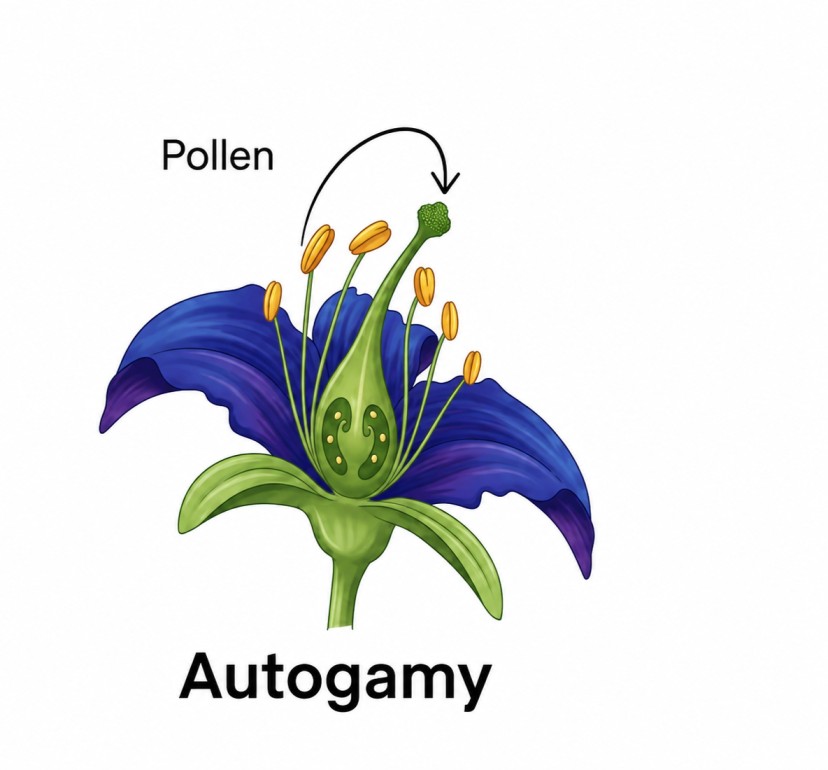
When pollen is transferred from the anther to the stigma of the same flower, it is called autogamy.
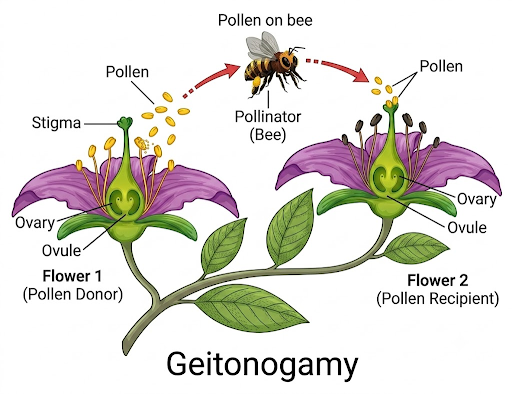
When pollen is transferred from one flower to another flower on the same plant, it is called geitonogamy.
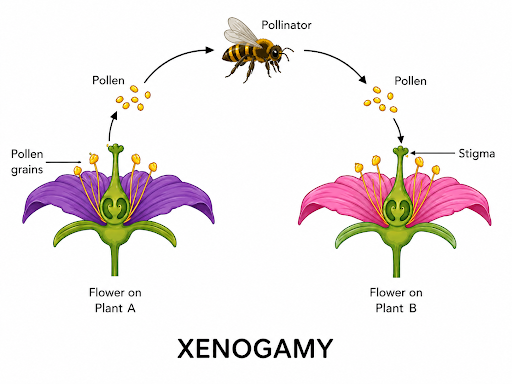
When pollen is transferred from one plant to a flower on another plant of the same species, it is called xenogamy.
Thus:
Agents of Pollination
Pollen grains can be transferred from anther to stigma by different agents.
Wind is an important agent in wind-pollinated flowers. Such flowers generally produce large quantities of light and non-sticky pollen grains.
Example: Corn cob
Water acts as a pollinating agent in a few aquatic flowering plants.
Example: Vallisneria, Zostera
Water hyacinth and water lily are not water- pollinated (pollination occurs through insects or wind)
Insects and other animals can also transfer pollen between flowers. Insect-pollinated flowers often have features such as attractive colours, fragrance, and nectar that help attract pollinators.
Plants have also developed different mechanisms that reduce self-pollination and promote cross-pollination. These are known as outbreeding devices.
Outbreeding Devices
Prevent self-pollination through:
Different timing of pollen release and stigma receptivity.
Different positions of anther and stigma.
Self-incompatibility.
Production of unisexual flowers.
Monoecious vs Dioecious
Monoecious: male + female flowers on same plant.
Prevents autogamy.
Does not prevent geitonogamy.
Examples: maize, castor.
Dioecious: male + female flowers on different plants.
Prevents both autogamy and geitonogamy.
Example: papaya.
Artificial Hybridisation
Used to ensure that only desired pollen reaches the stigma.
Emasculation: removal of anthers before dehiscence from the selected bisexual female parent.
Bagging: covering the emasculated flower to prevent unwanted pollen contamination.
When the stigma becomes receptive → desired pollen is applied → rebagging.
If the female parent is unisexual, emasculation is unnecessary.
Pollen-Pistil Interaction
Pollination does not automatically lead to fertilisation. Once a pollen grain reaches the stigma, it must be recognised as compatible by the pistil.
The pistil can recognise whether the pollen is compatible or incompatible.
- Compatible pollen: The pistil recognises compatible pollen and permits its germination and pollen tube growth.
- Incompatible pollen: The pistil rejects the pollen by preventing pollen germination or inhibiting pollen tube growth in the style.
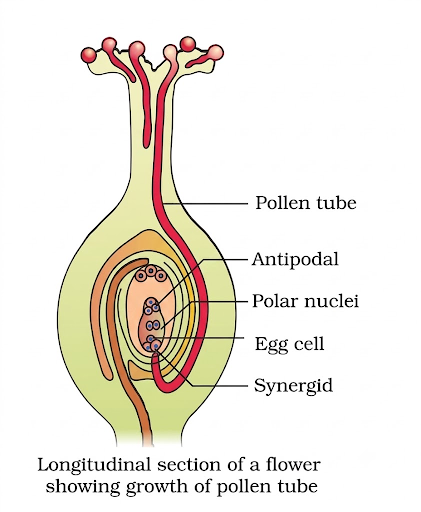
A pollen tube emerges from the pollen grain and grows through the style towards the ovary.
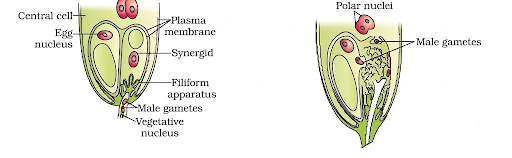
The pollen tube eventually enters an ovule and reaches the embryo sac. The two male gametes are transported through the pollen tube.
This movement of the pollen tube from the stigma towards the embryo sac forms an important part of pollen-pistil interaction.
Entry of the Pollen Tube into the Embryo Sac
The pollen tube usually enters the ovule through the micropyle and reaches the embryo sac.
It enters one of the synergids at the micropylar end. The synergids contain a specialised structure called the filiform apparatus, which plays an important role in guiding the pollen tube.
The pollen tube eventually releases the two male gametes into the embryo sac.
At this point, the two male gametes are ready to participate in two separate fusion events.
Fertilisation
Fertilisation in flowering plants involves two fusion events occurring within the same embryo sac.
Syngamy
One male gamete fuses with the egg cell to form a diploid zygote.
This fusion of the male gamete with the egg is called syngamy.
Male gamete + Egg → Zygote
The zygote later develops into the embryo.
Triple Fusion
The second male gamete moves towards the central cell and fuses with the two polar nuclei, or with the secondary nucleus formed by their fusion.
Since three nuclei are involved in this fusion – one male gamete nucleus and two polar nuclei – the process is called triple fusion.
This produces the primary endosperm nucleus, which is triploid.
Male gamete + two polar nuclei → Primary endosperm nucleus
The primary endosperm nucleus later gives rise to the endosperm, which provides nourishment to the developing embryo.
Double Fertilisation
Both syngamy and triple fusion occur within the same embryo sac.
The occurrence of these two fusion events in a flowering plant is called double fertilisation.
The sequence can be represented as:
Two male gametes enter the embryo sac
↓
First male gamete + Egg → Zygote
Second male gamete + Two polar nuclei → Primary endosperm nucleus
↓
Syngamy + Triple fusion = Double fertilisation
Double fertilisation is a characteristic feature of flowering plants.
What Happens After Double Fertilisation?
The two products formed through double fertilisation have different developmental fates.
The zygote develops into the embryo.
The primary endosperm nucleus undergoes divisions and develops into the endosperm, which nourishes the developing embryo.
The events that follow fertilisation eventually lead to the formation of the seed and fruit:
Zygote → Embryo
Primary endosperm nucleus → Endosperm
Ovule → Seed
Ovary → Fruit
The Complete Sequence
The events can now be connected into one continuous process:
Pollination → Compatible pollen reaches stigma → Pollen germination → Pollen tube formation → Pollen tube growth through style → Entry into ovule and embryo sac → Release of two male gametes → Syngamy + Triple fusion → Double fertilisation → Zygote + Primary endosperm nucleus
This sequence connects pollination with the beginning of post-fertilisation development.
Important Points to Remember
- Pollination is the transfer of pollen grains from anther to stigma.
- Autogamy occurs within the same flower.
- Geitonogamy occurs between flowers of the same plant.
- Xenogamy occurs between flowers of different plants of the same species.
- Compatible pollen germinates on the stigma and forms a pollen tube.
- The pollen tube carries two male gametes towards the embryo sac.
- One male gamete fuses with the egg during syngamy.
- The other male gamete fuses with the two polar nuclei during triple fusion.
- Syngamy and triple fusion together constitute double fertilisation.
- The zygote develops into the embryo.
- The primary endosperm nucleus develops into the endosperm.
FAQs
Pollination is the transfer of pollen grains from the anther to the stigma of a flower.
The three types are:
- Autogamy – pollen transfer within the same flower
- Geitonogamy – pollen transfer between two flowers of the same plant
- Xenogamy – pollen transfer between flowers of two different plants of the same species
Wind-pollinated flowers generally have light and non-sticky pollen, exposed stamens, and large, feathery stigmas. These features help pollen move through the air and get trapped by the stigma.
Insect-pollinated flowers are often colourful, fragrant, and rich in nectar. Their pollen grains are generally sticky,so that insects can carry them from one flower to another.
Pollen-pistil interaction is the process through which the pistil recognises compatible or incompatible pollen. Compatible pollen germinates on the stigma and produces a pollen tube that grows towards the ovule.
Syngamy is the fusion of one male gamete with the egg cell. It produces a diploid zygote.
Triple fusion is the fusion of the second male gamete with the two polar nuclei in the central cell. It produces the primary endosperm nucleus, which is usually triploid.
The zygote is diploid (2n) because it is formed by the fusion of two haploid gametes. The primary endosperm nucleus is usually triploid (3n) because it is formed by the fusion of one male gamete (n) with two polar nuclei (n + n).