

What is Boyle’s Law?
Boyle’s Law states that the pressure exerted by a fixed mass of gas is inversely proportional to its volume at constant temperature.
( സ്ഥിരമായ താപനിലയിൽ, ഒരു നിശ്ചിത മാസ് വാതകത്തിന്റെ വ്യാപ്തം അതിന്റെ മർദത്തിന് വിപരീത അനുപാതത്തിലായിരിക്കും.)
Boyle’s Law: Relation Between Pressure and Volume
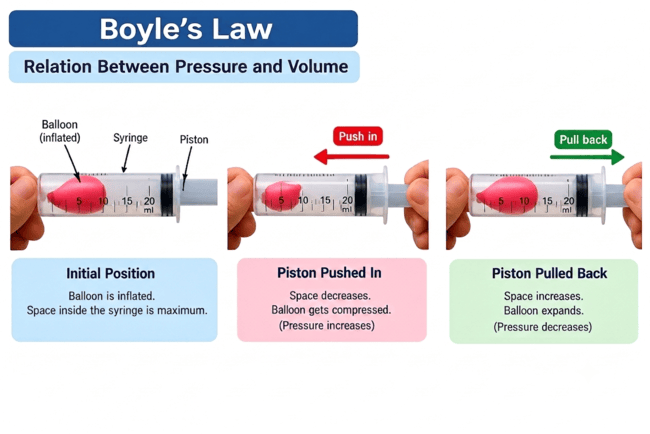
Imagine a small inflated balloon placed inside a syringe. When the syringe piston is pushed inward, the available space inside the syringe decreases. The balloon gets compressed. When the piston is pulled back, the available space increases and the balloon expands again.
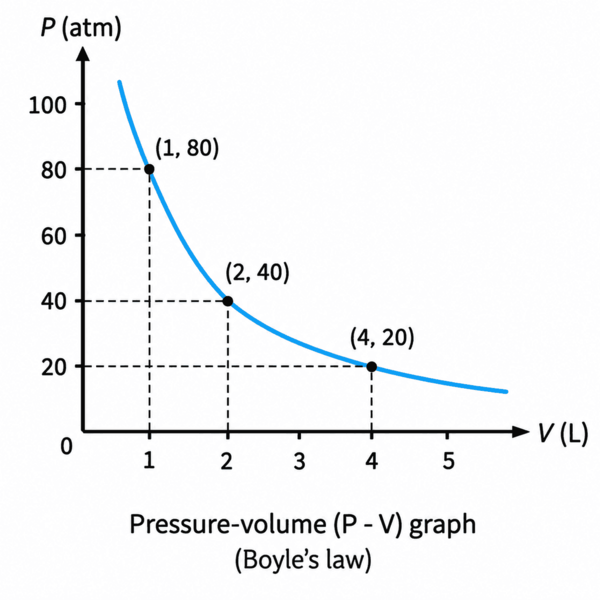
The graph shows the relationship between the pressure (P) and volume (V) of a fixed amount of gas at constant temperature.
- Volume (V) is shown on the X-axis.
- Pressure (P) is shown on the Y-axis.
- The curve slopes downward, showing that pressure decreases as volume increases.
- For example, when the volume is 1 L, the pressure is 80 atm. When the volume increases to 2 L, the pressure decreases to 40 atm.
- When the volume increases further to 4 L, the pressure decreases to 20 atm.
- Thus, the graph shows that pressure and volume are inversely proportional.
This simple activity shows that pressure and volume of a gas are inversely related.
Ready to Crack Your Entrance Exam in 2027?
Join Xylem Learning today and start your entrance exam preparation!
Register NowWhat Happens When Pressure Increases?
Consider a fixed mass of gas kept in a cylinder with a freely movable piston. If the temperature is kept constant and pressure is increased, the volume of the gas decreases.
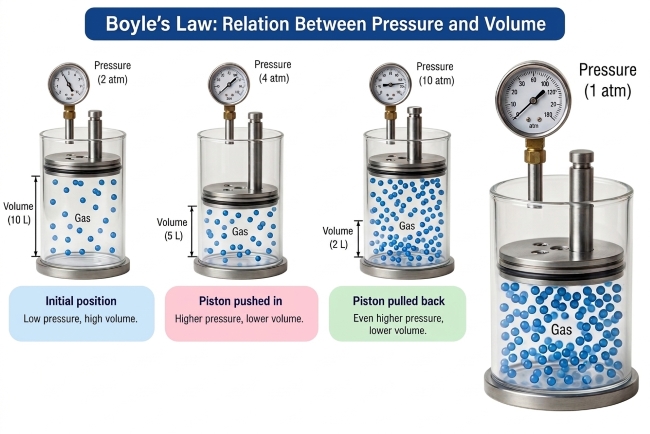
| Pressure (atm) | Volume (L) |
|---|---|
| 2 | 10 |
| 4 | 5 |
| 10 | 2 |
The table shows that as pressure increases, the volume decreases. This relationship was proposed by Robert Boyle in 1662.
Statement of Boyle’s Law
At constant temperature, the volume of a fixed mass of gas is inversely proportional to its pressure.
Here, k is a constant for a particular fixed mass of gas at constant temperature
Formula of Boyle’s Law
According to Boyle’s Law, for a fixed amount of gas kept at constant temperature, the pressure of the gas is inversely proportional to its volume.
Therefore, when the volume of a gas changes, its pressure also changes. The product of the pressure and volume of a fixed amount of gas remains constant at constant temperature.
This can be written as:
PV = k
where k is a constant.
Suppose the initial pressure and volume of a gas are P₁ and V₁, and the final pressure and volume are P₂ and V₂.
For the initial state:
P₁V₁ = k
For the final state:
P₂V₂ = k
Therefore,
P₁V₁ = P₂V₂
where:
- P₁ = initial pressure of the gas
- V₁ = initial volume of the gas
- P₂ = final pressure of the gas
- V₂ = final volume of the gas
Thus, P₁V₁ = P₂V₂ is the mathematical form of Boyle’s Law. It can be used to find the change in pressure or volume of a gas when the other quantity changes, provided the amount of gas and temperature remain constant.
Simple Example of Boyle’s Law
Suppose a fixed mass of gas has a volume of 44 L at 1 atm pressure. If the pressure is increased to 4 atm, its new volume can be calculated as:
P1V1 = P2V2
1 × 44 = 4 × V2
V2= 444 = 11 L
So, the volume becomes 11 L.
Applications of Boyle’s Law
Boyle’s Law can be used to explain several everyday observations.
- Weather balloons: As a weather balloon rises to higher altitudes, the surrounding atmospheric pressure decreases. At nearly constant temperature, the volume of the gas inside the balloon increases.
- Air bubbles in water: An air bubble rising from the bottom of an aquarium experiences decreasing pressure as it approaches the surface. Therefore, its volume increases.
Boyle’s Law is an important topic in SSLC Chemistry Chapter 4 – Gas Laws and Mole Concept. Understanding how pressure and volume change at constant temperature makes it easier to study gas behaviour and solve related problems. Regular practice with the equation and examples can help build a strong foundation in gas laws.
FAQ's
Boyle’s Law states that at constant temperature, the volume of a fixed mass of gas is inversely proportional to its pressure.
At constant temperature, the volume of a fixed mass of gas decreases when its pressure increases.
The relationship can be written as:
PV = k. For two different conditions: P1V1=P2V2
At constant temperature, the volume of a definite mass of gas decreases when its pressure increases.
The P–V graph shows the inverse relationship between pressure and volume. As pressure increases, volume decreases, while the product PV remains constant.