

Ligands are an essential part of coordination compounds because they provide the electron pairs that form coordinate bonds with the central metal atom or ion. They can be classified based on the number of donor atoms involved in bonding and the way they coordinate with the metal.
What Is a Ligand?
A ligand is an ion or molecule that donates one or more electron pairs to a central metal atom or ion to form a coordinate bond. The atom of the ligand that directly donates the electron pair is called the donor atom.
For example, in [Cu(NH₃)₄]²⁺, each NH₃ molecule donates a lone pair from its nitrogen atom to Cu²⁺. Therefore, nitrogen is the donor atom.
The number of donor atoms through which a ligand attaches to a single metal ion is called its denticity.
1. Monodentate Ligands
Monodentate ligands are ligands that bind to a central metal atom or ion through only one donor atom.
The word mono means one.
Examples include:
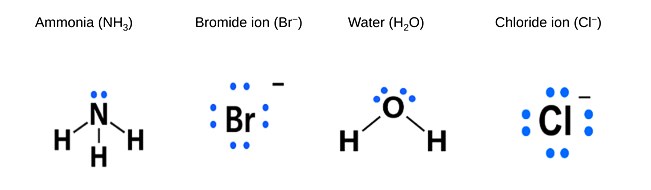
- NH₃ → binds through the nitrogen atom
- Br⁻ → binds through the bromine atom
- H₂O → binds through the oxygen atom
- Cl⁻ → binds through the chlorine atom
Therefore:
Monodentate → 1 donor atom
For example, NH₃ coordinates with a metal through its nitrogen atom.
2. Bidentate Ligands
A bidentate ligand is a ligand that coordinates to the same metal ion through two donor atoms.
The word bi means two.
Common examples include:
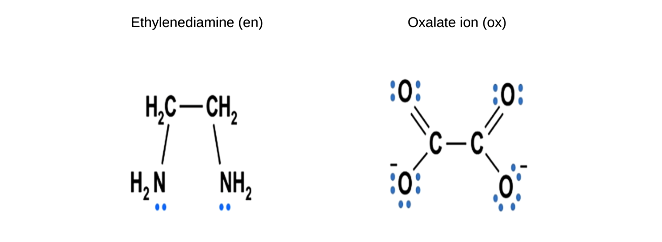
Ethane-1,2-diamine, commonly represented as en, contains two nitrogen donor atoms. Both nitrogen atoms can coordinate with the same metal ion.
Therefore: Bidentate → 2 donor atoms
Ready to Score Better in Your Class 12 Exams?
Join Xylem Online Tuition and learn your subjects step by step, with simple explanations and regular practice.
Register NowBidentate Ligand and Coordination Number
The number of ligand molecules and the coordination number are not always the same.
For example, in: [Co(en)₃]³⁺
There are three en ligand molecules, but each en ligand has two donor atoms.
Therefore:
Coordination number = 3 × 2 = 6
This difference is important when determining the coordination number of a complex.
3. Polydentate Ligands
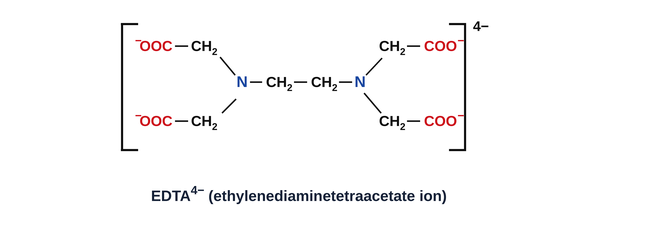
A polydentate ligand is a ligand that coordinates to the same metal ion through three or more donor atoms. An important example is EDTA⁴⁻.
EDTA is a hexadentate ligand because it can coordinate with the same metal ion through six donor atoms: two nitrogen atoms and four oxygen atoms.
Polydentate ligands can therefore form several coordinate bonds with the same metal ion.
Example:
4. Ambidentate Ligands
An ambidentate ligand is a ligand that can coordinate to the metal ion through two different donor atoms, but only one donor atom coordinates at a time.
Two important examples are NO₂⁻ and SCN⁻.
Nitrite Ion, NO₂⁻
NO₂⁻ can coordinate through either nitrogen or oxygen:
- Through N → nitro form
- Through O → nitrito form
Thiocyanate Ion, SCN⁻
SCN⁻ can coordinate through either:
- S → thiocyanato
- N → isothiocyanato
The ability of an ambidentate ligand to coordinate through different donor atoms can result in linkage isomerism.
Remember: An ambidentate ligand has two possible donor atoms, but it uses only one donor atom at a time to coordinate with the metal.
Bidentate vs Ambidentate
These two terms are often confused.
- Bidentate: two donor atoms coordinate with the same metal ion simultaneously.
- Ambidentate: two different donor atoms are available, but only one coordinates with the metal at a time.
5. Chelating Ligands
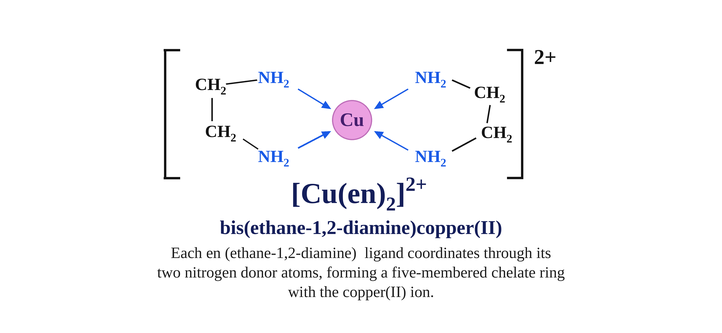
A chelating ligand is a ligand that coordinates to the same metal ion through two or more donor atoms and forms one or more rings with the metal. The ring formed between the ligand and the metal is called a chelate ring.
Chelating ligands generally form more stable complexes than comparable monodentate ligands. This increased stability is known as the chelate effect.
For example, in [Cu(en)₂]⁺, each en ligand coordinates through its two nitrogen donor atoms and forms a five-membered chelate ring with the copper(I) ion.
Ligands Based on the Nature of the Donor Atom
Ligands can also be classified according to the atom that donates the electron pair to the metal.
N-Donor Ligands
Ligands that coordinate with the metal through a nitrogen donor atom are called N-donor ligands.
Examples include:
- NH₃
- en
O-Donor Ligands
Ligands that coordinate through an oxygen donor atom are called O-donor ligands.
Examples include:
- H₂O
- OH⁻
- Oxalate
S-Donor Ligands
Ligands that coordinate through a sulfur donor atom are called S-donor ligands. For example, SCN⁻ can coordinate through sulfur.
The donor atom is important because changing the atom through which an ambidentate ligand coordinates can produce different coordination compounds and, in suitable cases, linkage isomers.
Homoleptic and Heteroleptic Complexes
Coordination complexes can also be classified according to the number of different types of ligands present.
Homoleptic Complex
A homoleptic complex contains only one type of ligand.
Example:
[Co(NH₃)₆]³⁺
All six ligands are NH₃.
Heteroleptic Complex
A heteroleptic complex contains more than one type of ligand.
Example:
[Co(NH₃)₄Cl₂]⁺
It contains two types of ligands: NH₃ and Cl⁻.
This classification helps identify the composition of a coordination complex quickly.
Quick Revision: Types of Ligands
| Type | Meaning | Example |
|---|---|---|
| Monodentate | One donor atom | NH3 |
| Bidentate | Two donor atoms coordinate with the same metal | en |
| Polydentate | Three or more donor atoms coordinate with the same metal | EDTA |
| Ambidentate | Two possible donor atoms, but one coordinates at a time | NO2−, SCN− |
| Chelating | Two or more donor atoms bind to the same metal and form ring(s) | en, EDTA |
| N-donor | Coordinates through nitrogen | NH3, en |
| O-donor | Coordinates through oxygen | H2O, OH− |
| S-donor | Coordinates through sulfur | SCN− |
FAQs
A ligand is an ion or molecule that donates one or more electron pairs to a central metal atom or ion to form one or more coordinate covalent bonds.
Denticity is the number of donor atoms of a ligand that coordinate with the same central metal atom or ion.
A monodentate ligand coordinates with a metal ion through a single donor atom. Examples include NH₃, H₂O, Cl⁻, and Br⁻.
A bidentate ligand coordinates with the same metal ion through two donor atoms. Examples include ethylenediamine (en) and oxalate (C₂O₄²⁻).
Ethylenediamine has two nitrogen donor atoms, and both can coordinate with the same metal ion. Therefore, en is a bidentate ligand.
EDTA⁴⁻ can coordinate with a metal ion through six donor atoms: two nitrogen atoms and four oxygen atoms. Therefore, EDTA is called a hexadentate ligand.
An ambidentate ligand has two different donor atoms through which it can coordinate, but it coordinates through only one donor atom at a time. Examples include NO₂⁻ and SCN⁻.
A bidentate ligand uses two donor atoms simultaneously to coordinate with the same metal ion, whereas an ambidentate ligand has two possible donor atoms but uses only one donor atom at a time.
A chelating ligand coordinates with the same metal ion through two or more donor atoms and forms one or more rings involving the metal. Ethylenediamine (en) and EDTA are important examples.
Each en ligand is bidentate and contributes two donor atoms. Therefore: 3×2=6
Hence, the coordination number of [Co(en)₃]³⁺ is 6.