

Matter around us exists in different forms, such as solids, liquids, and gases. Each state has its own properties based on the arrangement and movement of its particles. In this chapter, the behaviour of gases is explored through gas laws, which explain the relationship between pressure, volume, and temperature. The Gas Laws and Mole Concept chapter also introduces the mole concept, which helps understand the amount of a substance and perform calculations involving atoms, molecules, and chemical reactions.
Physical States of Substances
Matter around us exists in different physical forms.
Based on the arrangement, spacing, and movement of their particles, substances are commonly classified into three states: solid, liquid, and gas.
Each state has its own characteristics, which can be understood by looking at how its particles are arranged and how freely they move.
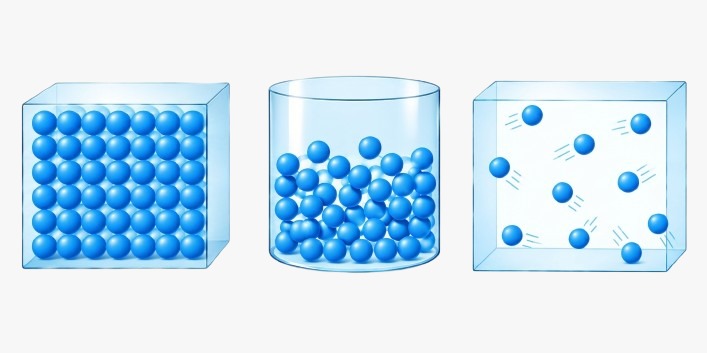
| Physical State | Definition | Examples |
|---|---|---|
| Solid | A substance that has a fixed shape and fixed volume. Its particles are closely packed and have very little freedom of movement. | Stone, book, pencil, ice |
| Liquid | A substance that has a fixed volume but no fixed shape. It takes the shape of the container in which it is kept. | Water, milk, oil |
| Gas | A substance that has neither a fixed shape nor a fixed volume. It spreads out and fills the available space. | Oxygen, carbon dioxide, water vapour |
Kinetic Molecular Theory of Gases
Key Points of the Theory
- Gases consist of tiny particles such as atoms or molecules.
- There is no attraction between gas molecules.
- The molecules are far apart, and their volume is negligible compared with the gas volume.
- Gases can be compressed by reducing the distance between molecules.
- Gas molecules are in constant random motion. Their collisions with the container walls produce pressure.
- Collisions between molecules are perfectly elastic, with no loss of kinetic energy.
- The average kinetic energy of gas molecules is directly proportional to their absolute temperature.
General Properties of Gases
The main measurable properties of a gas are volume, pressure, and temperature.
Volume
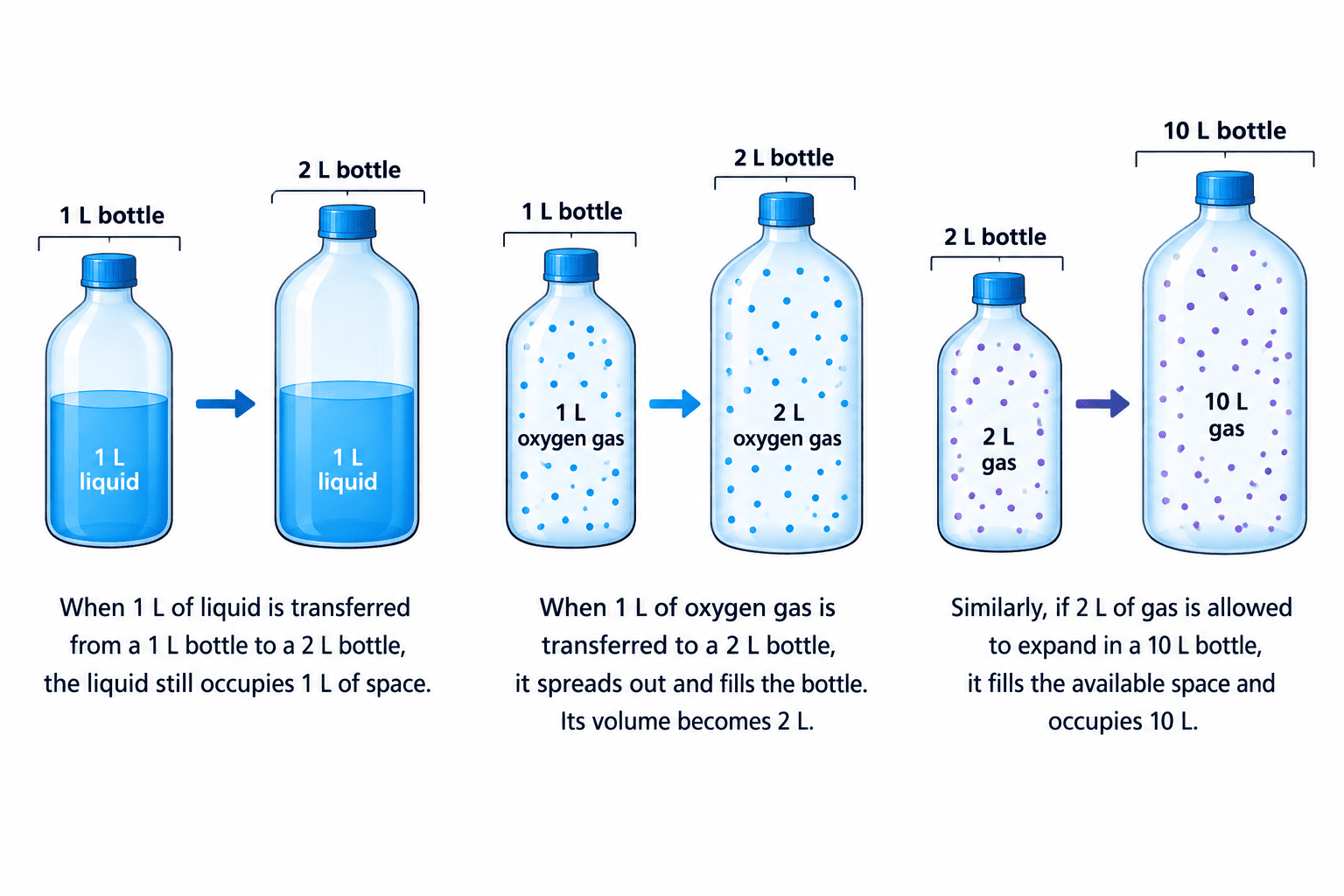
The space occupied by a substance is taken as its volume.
(ഒരു പദാർഥത്തിന് സ്ഥിതി ചെയ്യാനാവശ്യമായ സ്ഥലമാണ് അതിന്റെ വ്യാപ്തം)
- The volume of a gas is the volume of the container in which it is contained.
Ready to Learn SSLC Chemistry Better?
Learn, practise, and prepare with Xylem Online Tuition.
Register NowUnits of Volume
The commonly used unit for expressing the volume of a gas is litre (L).
A cube with a length, breadth, and height of 1 cm has a volume of 1 cm3.
Also,
where cc means cubic centimetre.
Therefore,
SI Unit of Volume
The SI unit of volume is cubic metre (m³).
A cube measuring 1 m × 1 m × 1 m has a volume of 1 m³.
Therefore,
1 m³ = 1 m × 1 m × 1 m
= 100 cm × 100 cm × 100 cm
= 1,000,000 cm³
Since 1 cm³ = 1 mL,
1 m³ = 1,000,000 mL
Since 1000 mL = 1 L,
1 m³ = 1000 L
Therefore, 1 m³ = 1000 L.
Pressure
The force acting normally on a unit area of a surface is called pressure.
(യൂണിറ്റ് പരപ്പളവിൽ ലംബമായി അനുഭവപ്പെടുന്ന ബലമാണ് മർദം.)
Pressure is the force acting per unit surface area.
P = F/A
The atmosphere (atm) is commonly used to express pressure. The SI unit of pressure is the pascal (Pa).
1 atm = 1.01325 × 10⁵ Pa
Temperature
Temperature is the measure of the degree of hotness or coldness of a substance.
(ഒരു പദാർഥത്തിന്റെ ചൂടിന്റെയോ തണുപ്പിന്റെയോ അളവാണ് താപനില.)
- Temperature is another measurable property of a gas.
- The energy possessed by gas molecules due to their motion is called kinetic energy.
The SI unit of temperature is Kelvin (K).
If the temperature is t°C, then:
What Are Gas Laws?
Gas laws describe the relationship between the measurable properties of a gas. The three important properties considered in these laws are:
- Pressure (P)
- Volume (V)
- Temperature (T)
Gas Laws: Understanding the Behaviour of Gases
The volume, pressure, and temperature of gases change when the surrounding conditions change. Gas laws explain the relationships between these properties.
The three important gas laws discussed here are Boyle’s law, Charles’s law, and Avogadro’s law.
Each law describes how one property of a gas changes when another property changes while specific conditions are kept constant.
| Gas law | Condition Kept Constant |
Main Equation (k=constant) |
Simple Explanation |
|---|---|---|---|
| Boyle’s Law: The volume of a fixed amount of gas decreases as its pressure increases. | Temperature |
PV = k P₁V₁ = P₂V₂ |
As pressure increases, volume decreases. |
| Charles’s Law: The volume of a fixed amount of gas increases with temperature. | Pressure |
V
T
= k
V₁ T₁ = V₂ T₂ |
As temperature increases, volume increases. |
| Avogadro’s Law: The volume of a gas increases as the amount of gas increases. | Temperature and pressure | V ∝ N | As the number of molecules increases, volume increases. |
Mole Concept
What is a Mole?
A mole is the amount of a substance that contains 6.022 × 10²³ particles. These particles may be atoms, molecules, ions, or other specified particles.
The number 6.022 × 10²³ is called the Avogadro number or Avogadro constant, represented by Nₐ.
For example:
- 1 mole of water contains 6.022 × 10²³ water molecules.
- 1 mole of oxygen atoms contains 6.022 × 10²³ oxygen atoms.
The mole is the SI unit of the amount of substance. It provides a convenient way to express the enormous number of particles present in a substance.
Relative Atomic Mass and Mole
Relative atomic mass is the mass of an atom of an element compared with 1/12 of the mass of a carbon-12 atom.
The mass of 1/12 of a carbon-12 atom is taken as one unified atomic mass unit, represented by u.
Therefore, the relative atomic mass of an element can be expressed by comparing the mass of its atom with this standard.
For example:
| Element | Average Atomic Mass | Relative Atomic Mass |
|---|---|---|
| Hydrogen | 1.0079 | 1 |
| Carbon | 12.011 | 12 |
| Nitrogen | 14.0067 | 14 |
| Oxygen | 15.9994 | 16 |
| Sodium | 22.989 | 23 |
Gram Atomic Mass
When the relative atomic mass of an element is expressed in grams, the resulting mass contains 6.022 × 10²³ atoms, which is equal to 1 mole of atoms. This mass is called the gram atomic mass of the element.
Molar Mass
Molar mass is the mass of one mole of a substance and is expressed in gmol−1.
How to Calculate Molecular Mass?
The chemical formula of carbon dioxide is CO₂.
- Atomic mass of C = 12
- Atomic mass of O = 16
| Element/Compound | Chemical formula | Molecular mass |
|---|---|---|
| Oxygen | O2 | (2 × 16) = 32 |
| Ammonia | NH3 | 14 + (3 × 1) = 17 |
| Water | H2O | (2 × 1) + 16 = 18 |
| Glucose | C6H12O6 | (6 × 12) + (12 × 1) + (6 × 16) = 180 |
| Sulphuric acid | H2SO4 | (2 × 1) + 32 + (4 × 16) = 98 |
| Nitrogen | N2 | (2 × 14) = 28 |
Gram molecular mass
If 6.022 × 10²³ oxygen molecules are taken, their mass is 32 g. This is the molecular mass of oxygen (32 u) expressed in grams and is called the gram molecular mass of oxygen.
Therefore, 1 mole of oxygen molecules has a mass of 32 g.
Dalton
- Dalton (Da) is a unit used to express atomic and molecular masses. It is a non-SI unit accepted for use with SI units and is equivalent to the unified atomic mass unit (u).
Calculating the Number of Moles
The number of moles in a given mass of a substance can be calculated using its molar mass.
Formula:
- Number of moles = Given mass / Molar mass
- Number of molecules=Number of moles × 6.022 × 10²³
Volume of gases and moles
Avogadro’s Law and Volume of Gases
According to Avogadro’s law, equal volumes of different gases at the same temperature and pressure contain an equal number of molecules. This means that the volume occupied by a gas depends on the number of molecules present when temperature and pressure remain constant.
Molar Volume of a Gas at STP
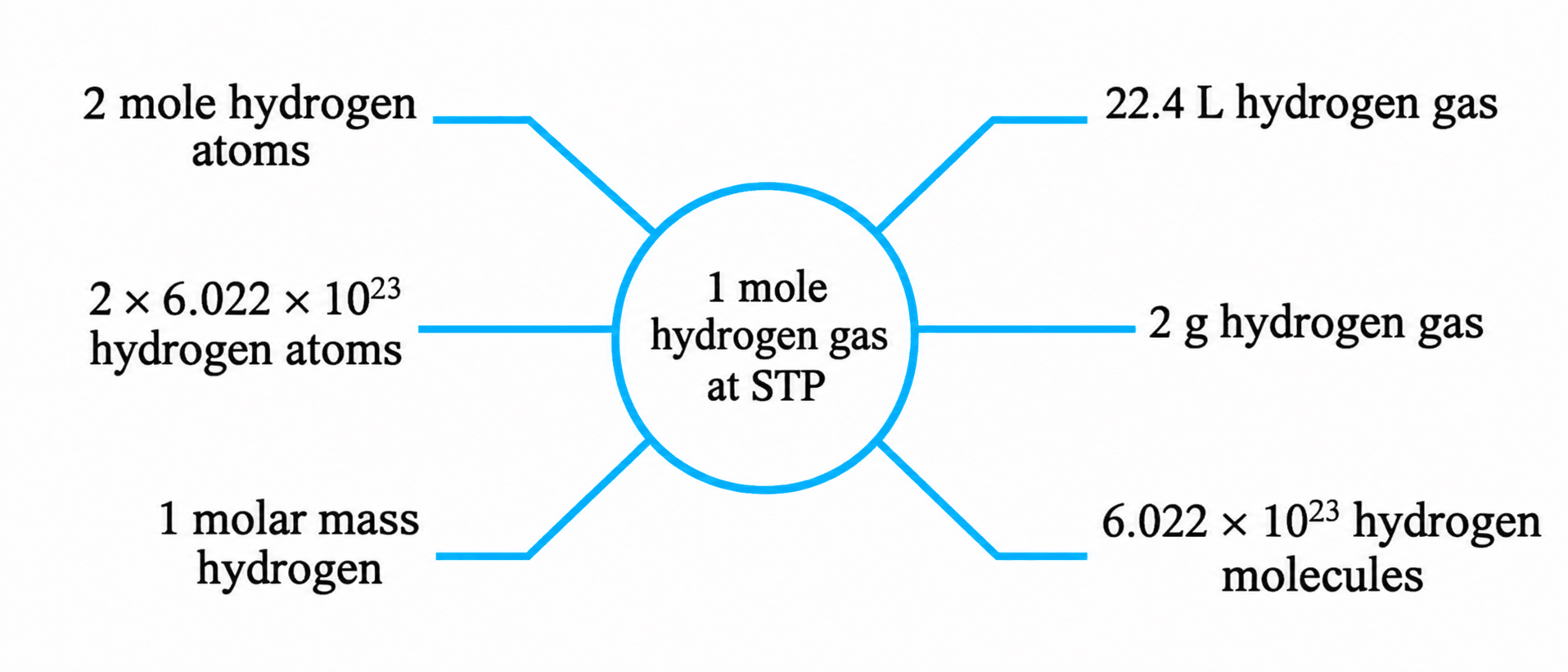
When the temperature is 273 K and the pressure is 1 atm, the conditions are called STP (Standard Temperature and Pressure).
At STP:
1 mole of any gas = 22.4 L
- The volume occupied by one mole of a gas at STP is called its molar volume.
- At STP, one mole of any gas occupies 22.4 L. This is called the molar volume of a gas at STP.
Ready to Learn SSLC Chemistry Better?
Learn, practise, and prepare with Xylem Online Tuition.
Register NowIdeal Gas Law
The ideal gas laws describe how the pressure, volume, temperature, and amount of a gas are related.
Ideal Gas Equation
The ideal gas equation shows the relationship between the pressure, volume, temperature, and number of moles of a gas.
The equation is obtained by combining Boyle’s law, Charles’s law, and Avogadro’s law.
From the Gas Laws
V ∝ n (Pressure and temperature are constant)
Combining these relationships:
V ∝ nT P
Therefore,
PV ∝ nT
or,
Ideal Gas Equation
Mole Concept and Chemical Equations
A balanced chemical equation gives important information about the number of molecules or moles taking part in a reaction. By using the mole concept, we can also calculate the mass of reactants and products involved in a chemical reaction.
Mole Ratio in a Chemical Equation
Consider the reaction between hydrogen and oxygen:
2H₂ + O₂ → 2H₂O
This equation shows that:
- 2 molecules of hydrogen react with 1 molecule of oxygen.
- 2 molecules of water are formed.
The same ratio can be expressed in terms of moles:
2 mol H₂ + 1 mol O₂ → 2 mol H₂O
So, the mole ratio is:
H₂ : O₂ : H₂O = 2 : 1 : 2
Chemical Equation in Terms of Mass
The molar masses are:
- H₂ = 2 g/mol
- O₂ = 32 g/mol
- H₂O = 18 g/mol
Therefore:
2 mol H₂ + 1 mol O₂ → 2 mol H₂O
can be written as:
4 g H₂ + 32 g O₂ → 36 g H₂O
This means that 4 g of hydrogen reacts completely with 32 g of oxygen to produce 36 g of water.
Example: Finding the Mass of Water Formed
How much water is produced when 40 g of hydrogen reacts completely with oxygen?
From the equation:
4 g H₂ → 36 g H₂O
Therefore:
1 g H₂ → 36/4 = 9 g H₂O
So,
40 g H₂ → 9 × 40 = 360 g H₂O
Therefore, 360 g of water is produced.
Finding the Required Mass of Oxygen
From the equation:
4 g H₂ → 32 g O₂
Therefore:
1 g H₂ → 32/4 = 8 g O₂
For 40 g of hydrogen:
40 × 8 = 320 g O₂
Therefore, 320 g of oxygen is required to react completely with 40 g of hydrogen.
Finding the Amount of Reactant Required
Consider the reaction between hydrogen and oxygen:
2H₂ + O₂ → 2H₂O
In terms of mass:
4 g H₂ + 32 g O₂ → 36 g H₂O
Therefore, if 40 g of H₂ reacts completely with oxygen:
Mass of O₂ required = (32 ÷ 4) × 40
= 320 g
Answer: 320 g of O₂ is required.
Mole Ratio in the Formation of Ammonia
Ammonia is formed when nitrogen reacts with hydrogen:
N₂ + 3H₂ → 2NH₃
Mole Ratio
From the balanced equation:
1 mol N₂ + 3 mol H₂ → 2 mol NH₃
Therefore,
N₂ : H₂ : NH₃ = 1 : 3 : 2
Mass Relationship
The molar masses are:
- N₂ = 28 g/mol
- H₂ = 2 g/mol
- NH₃ = 17 g/mol
Therefore:
28 g N₂ + 6 g H₂ → 34 g NH₃
Limiting Reactant: Basic Application
Sometimes, one of the reactants is present in a smaller amount than required by the balanced equation. Such a reactant limits the amount of product that can be formed.
Consider:
N₂ + 3H₂ → 2NH₃
Suppose 6 mol N₂ reacts with 6 mol H₂.
The required mole ratio is:
N₂ : H₂ = 1 : 3
Therefore, 6 mol H₂ can react with only:
6 ÷ 3 = 2 mol N₂
The reaction is:
2 mol N₂ + 6 mol H₂ → 4 mol NH₃
Nitrogen remaining:
6 − 2 = 4 mol
Answer: 4 mol N₂ remains unreacted.
Here, H₂ is the limiting reactant because it is completely consumed first.
Mole Concept in the Combustion of Methane
Methane burns completely in oxygen to form carbon dioxide and water.
CH₄ + 2O₂ → CO₂ + 2H₂O
Mole Ratio
1 mol CH₄ + 2 mol O₂ → 1 mol CO₂ + 2 mol H₂O
Mass Relationship
The molar masses are:
- CH₄ = 16 g/mol
- O₂ = 32 g/mol
- CO₂ = 44 g/mol
- H₂O = 18 g/mol
Therefore:
16 g CH₄ + 64 g O₂ → 44 g CO₂ + 36 g H₂O
Mole Concept in Neutralisation Reactions
The mole concept can also be used to calculate the amount of a reactant required for a neutralisation reaction.
For example:
H₂SO₄ + Ca(OH)₂ → CaSO₄ + 2H₂O
The molar masses are:
- H₂SO₄ = 98 g/mol
- Ca(OH)₂ = 74 g/mol
From the balanced equation:
98 g H₂SO₄ reacts with 74 g Ca(OH)₂.
Understanding gas laws and the mole concept becomes easier with a clear grasp of the basic concepts and formulas, along with regular practice. From the properties of gases to mole calculations and chemical equations, each concept builds a strong foundation for learning Chemistry. For students seeking structured academic support alongside regular classes, study materials, and practice, explore the Xylem Online Tuition Classes to strengthen their Chemistry concepts and prepare with greater confidence.
FAQ's
6.022 × 10²³ is called the Avogadro constant. It represents the number of particles in one mole of a substance.
Number of moles = Given mass ÷ Molar mass
The mole ratio shows the relative amounts of reactants and products.
For example: 2H₂ + O₂ → 2H₂O H₂ : O₂ : H₂O = 2 : 1 : 2
A limiting reactant is the reactant that gets completely consumed first and limits the amount of product formed.
For example, in N₂ + 3H₂ → 2NH₃, if 6 mol N₂ reacts with 6 mol H₂, H₂ is the limiting reactant.
At STP (273 K and 1 atm), one mole of a gas occupies 22.4 L. This is called its molar volume.